Chapter 2
IN THE WORKSHOP
Might we have been mistaken? Perhaps the poem about the balloon is simply a unique phenomenon in terms of the interconnectedness of its planes? Let's examine another poetic excerpt that evokes an acute sense of sadness while not describing any sad events. We will pay attention only to the presence of the third plane, to that deep level of the verse from which the level of its common denominator opens up (Alexander Pushkin, “On Georgia’s Hills”, 1829):
On Georgia's hills lies the night mist.
Aragvi roars before me.
I am sad and light, my sorrow is bright.
My sorrow is filled with you.
The night mist on the hills evokes instability, transience, a precarious balance. Morning will come – and it will disappear – loss. Aragvi roars – the movement of a mountain river, eternal water change, one cannot step into the same river twice – instability, loss.
I am sad and light. My sorrow is bright.
Here we have two examples of inverse symmetry at once: in the word “sadness” the meaning of sorrow dominates, and in the word “lightness” – joy, as in the word “light”. And inverse symmetry, as we have already said, describes a situation fraught with loss. Moreover, Georgia and Aragvi are alien to the poet, something he is destined to lose.
My sorrow is filled with you.
Through this very act of “filling”, the woman who is the cause of the Poet's sorrow becomes an embodiment of sorrow herself.[8] One might think that she will be lost, like Georgia or Aragvi, or that, having remained in Russia, she is lost to the Poet, or that she does not love the Poet and is therefore already lost, or that the Poet grieves because he realizes that his love will pass, but still cannot help but love – from the perspective of the third plane it does not matter. What matters is that this too represents loss.
Examining each image in the verse for its ordinary meaning, we find that the images naturally fall into two groups in this quatrain by Pushkin. The first group comprises night, mist, hills, flowing waters, passing noise, sorrow, sadness, and woman. All images of this group, considered by themselves, outside the verse, have, among other qualities, the quality of sadness. Light, lightness – the second group. Its images are united by the opposite quality – joy. In the future, we will call groups consisting of images (words) united by a common meaning (seme) a semantic series. The entire set of images in the quatrain fit into two semantic series.
The process of identifying semantic series in verse parallels the mathematical process of factorization (forming a quotient structure), with the series themselves functioning as factor-sets (quotient sets). Factor-sets, as is well known, can possess properties not found in their constituent elements. These sets can themselves serve as elements for further operations.
Thus, we have identified new operational structural units in the verse: semantic series of images. The common seme of images in one semantic series essentially serves as the name or identifier of this series. Each appearance of images from this series serves as a repetition of the seme common to the entire series. Images within a single semantic series, as well as different semantic series with distinct identifiers (semes) identified within the same verse, enter into symmetrical relationships with one another. The symmetry of their relations can be simple and inversional.
Both semantic series identified in the above quatrain are connected by relations of inverse symmetry. The relations of inverse symmetry existing in Pushkin's poem flip the semantic series of joy and turn it, paradoxically, into its opposite: the semantic series of sadness. Thus, the application of inverse symmetry leads to the strengthening of one seme by others. As a rule, the seme that predominates in the work of art will be the one that is strengthened. Since all elements included in one semantic series are connected by relations of symmetry of repetition, the use of images that, in our perception, are reduced to a single semantic series leads to the creation of a suggestion formula (in a hypnotic sense) in the artwork.
To determine the leading seme of the verse[9] means to determine the content of the inner suggestion formula. The ability to form a suggestion formula is the first new property that a semantic series reveals as a factor-set. In our analysis of Bulat Okudzhava's poem, we saw that all structural levels of the poem participate in creating the suggestion formula – the story, the plot, the selection of images, and the selection of words.
With the above Pushkin’s quatrain, things are somewhat different. The plot of the poem does not indicate the suggestion formula at all. The poet contemplates a certain landscape and thinks about a woman. The deep meaning of the quatrain was revealed only after we dismantled the fabric of the verse and re-assembled it through montage. Is it appropriate to do this?
Montage: series of lexemes, fields of meaning, semantic series and suggestion formula
Yu. V. Pukhnachev, in his nuanced and interesting study,[10] writes about the montage nature of our vision, thanks to which montage pieces in the viewer's perception coalesce into a single image. Probably, we can talk about the montage nature of perception in general. When perceiving, we divide the fabric of an artwork into pieces (frames), and from them we assemble a single whole (semantic series). But might there be an error in our reasoning and analysis? Let's experiment by artificially constructing a series of lexemes, where each lexeme's meaning field contains the seme of loneliness.
We compiled a tree of 39 words sharing a common seme. Though chosen through free association, the words follow a natural semantic progression.
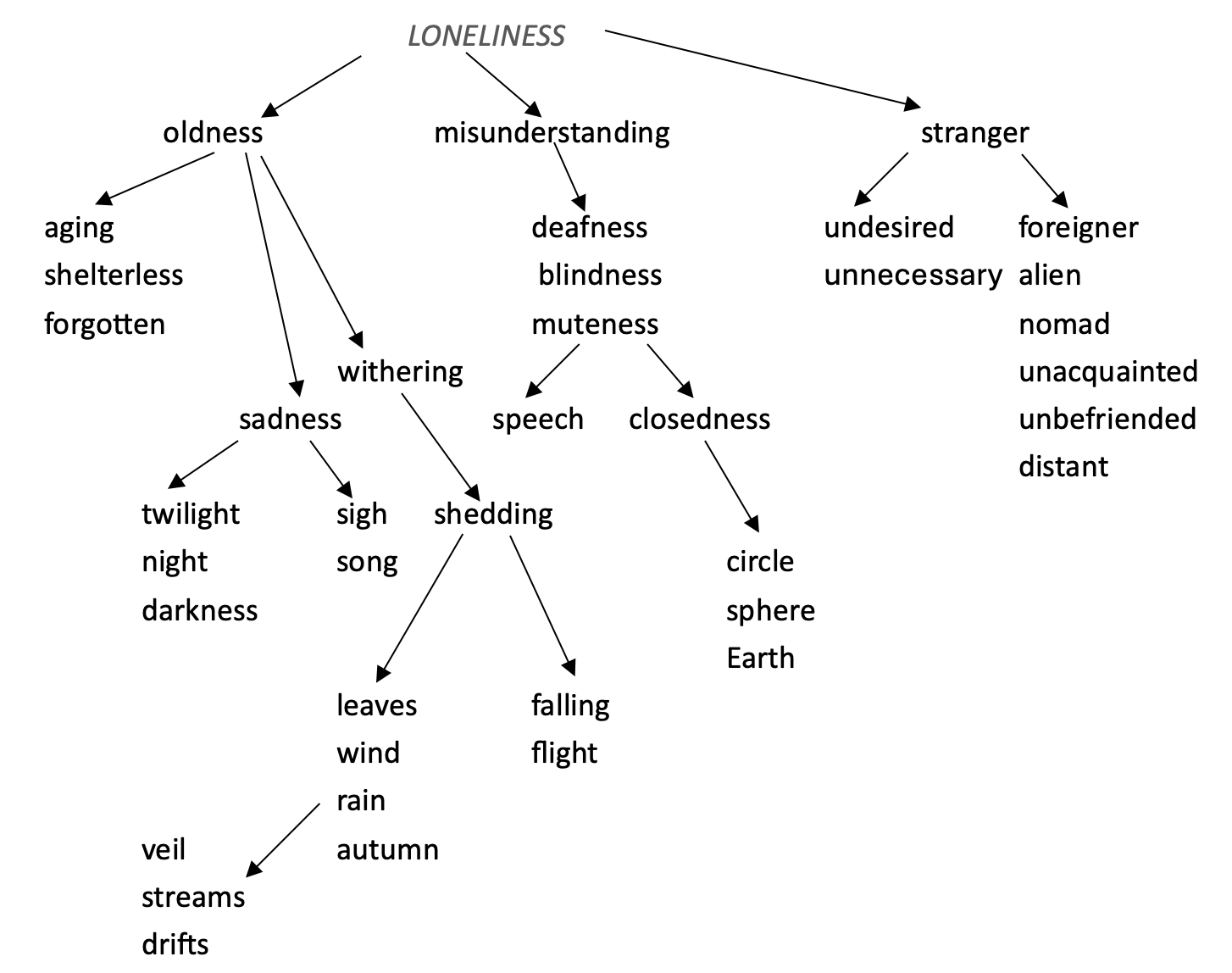
Using words from this series, let's compose several quatrains, paying attention only to grammatical correctness, rhythm, and rhyme, without concern for the meaning of the phrases. Many such quatrains can be composed from this series. We constructed several and invite the reader to exercise on their own. The quatrain can be composed literally by poking at words at random with a finger.
1. Age stands alone and undefended,
The distant twilight growing dim,
The autumn's circle unbefriended,
The rain, the Earth, and shadows grim.
2. A stranger's shadow, old and grey,
Moves through the darkness, undefined,
As withered songs of yesterday
Leave only silence, deaf and blind.
3. In autumn's circle, strangers meet
Where rain and sorrow interlace,
Their footsteps on the darkened street
Erase each other's fleeting trace.
4. The nomad darkness claims its sphere,
Through withered distance shadows glide,
While circles of the night draw near
And loneliness grows deep inside.
5. A rain of shadows, strange and deep,
Falls through the sphere of endless night,
Where circles of the darkness keep
Their shelterless nomadic flight.6. Through spheres of shadows, strange and deep,
The rain of endless night descends,
While darkness in its circles keeps
The nomad flight that never ends.
We are far from considering these quatrains poetry; they are predominantly awkward constructions, with the possible exception of a few of them. Yet each of them evokes a mood of sadness, with quatrains 2 and 3 evoking a particularly strong sad mood. This is not surprising: each word in them repeats the same seme of loneliness. The suggestion formula remains the same in all these verses; what differs is the degree of its realization. We will discuss this in more detail in Chapter 3.
The suggestion formula was most successfully created in the quatrains “about the strangers”. Notably, they demonstrate that logical connections in verse are not really important – we got the third quatrain by shaking up the words in the second quatrain and swapping the subject and object. We will even make a bold assumption: shamanic verse is shamanic verse precisely because it generally weakens logical connections between images, focusing on the third plane. This does not mean shamanic verse lacks logic – it has its own logic, the logic of semantic series, or, to look ahead, the logic of dreams.
Semantic Series and Incongruous Images
This reveals another property of semantic series: their ability to combine seemingly incongruous images in verse. As an example, let’s consider the following poem by Mandelstam (1933):
In needle-sharp plague goblets we
Drink strange obsessions of all causes,
With hooks touch measures, brief and free,
Like easy death that barely pauses.
And there where pick-up sticks now weave,
The child holds silence, still and steady,
Great Universe finds sweet reprieve
In small Eternity's soft cradle.
We invite readers to try to determine for themselves the content of the suggestion formula implemented in this verse. We will only hint that “easy death” refers to instantaneous death, and that measures as slight as easy death are so ephemeral that they exist on the threshold between being and non-being.
Let's consider another example from O. Mandelstam's work – an excerpt from his creative translation of Petrarch's sonnet (1934). Compare two versions of one line’s translation:
1. My days flew by like a running doe...
and
2. My days flew by as if of deer
A scything run...
The second version of the translation was done by O. Mandelstam. One needn't be a poetry expert to recognize that it is more vivid, powerful, and effective, even though Mandelstam's phrase stands, as they say, on its ears. “A scything run” – what is this? A run that scythes down deer? Or the run of deer being scythed down? And what is being scythed? And who wields the scythe? Reason stumbles on this phrase and begins cycling through all possible interpretations. The scything run of deer. The scythe that cuts the grass. Death with its scythe, cutting down deer. The scything motion of autumn rain... These images align into a series by virtue of being united by two semes – the seme of death, decay and the seme of swiftness, which in itself is included in the series of death (after all, the days have already flown by).[11]
One of the quoted lines creates a quite powerful suggestion formula. Pukhnachev writes: “What is reading if not solving, interpreting, extracting the secret that remained behind the lines, beyond the words. 'Reading is above all co-creation,' wrote Tsvetaeva.[12] And one recalls theoretical judgments about how deeply montage images are perceived in film, conditioned precisely by the fact that 'montage pieces work as irritants, provoking associations; the viewer's emotions and reason are included in the creative process; the viewer creates an image guided by these precise directorial cues; this is the same image that was conceived and created by the author, but this image is simultaneously created by the viewer's own creative act' (according to Eisenstein)”.[13]
The suggestion formula may either develop further or serve as an intermediate step, evoking an emotional ornament in the reader. It is clear that no analysis can encompass all the richness of associations, since everyone has their own life experience. In other words, no analysis can definitively measure the power of suggestion in an image, line, or verse. The depth of verse is, therefore, infinite.
But even at that rough level available to us, it is clear that the emotionally neutral line “My days flew by like a running doe” is not capable of evoking a deep series of associations colored by one seme of swiftness. The seme of death in the image of a running doe is not felt at all. Of course, it is there, but the probability of its realization is close to zero. The context of “My days flew by” turns out to be insufficient to reveal this seme in the image of a running doe.
Here we should pause and return to our awkward constructions of the quatrains. What we were doing in composing them was essentially creating a montage of word-elements, word-frames of some picture. And it's worth noting that cinematographers did something similar at the dawn of cinema. Indeed, they continue to do so today. Here's what Sergei Eisenstein, who devoted considerable time to developing the theory of montage, wrote:
The “Leftists” in matters of montage went to another extreme: while handling pieces of film, they discovered a certain property of montage which so impressed them that they could not shake off the impression for several years afterwards. This property reveals that any two pieces of a film stuck together inevitably combine to create a new concept, a new quality born of that juxtaposition.
<…>
In this case, each montage piece is not something unrelated, but becomes a particular representation of the general theme which in equal measure runs through all the shot-pieces.[14]
The juxtaposition of such particular details in a given montage construction produces the same whole and general which has given birth to each of the details, namely, the generalized image through which the author (and, after him, the spectator) relives the theme.[15]
Suppose we try to express what Eisenstein said in terms and concepts that we have introduced and used throughout this work. In that case, we get the following: all particular details are elements of one semantic series, and they are connected by relations of symmetry of repetition of the seme. The perception of all particular details leads to the repetition of their common seme (the Eisenstein’s generalized image in which the viewer experiences the theme in question), that is, to the formation of a suggestion formula. Suggestion presupposes a deep emotional state of experiencing suggested reality. This was the method we used to construct our quatrains. We utilized particular details (words, in our case) from within a single semantic series.
How accurately can one define the suggestion formula? And how effectively can its meaning be conveyed?
This question does not promise a simple answer. However, we have seen that understanding the role and means of creating the suggestion formula enables us to construct verse-like quatrains. Perhaps the suggestion formula will be the tool with which it will be possible to build a rigid model of a poem?
Let's consider the famous five-line poem by Velimir Khlebnikov (1908-1909)[16], over whose mystery probably every second philologist has pondered:
Bo-beh-o-bi, sang the lips,
Veh-eh-o-mi, sang the glances,
Gzy-gzy-gzeh-o, sang the chain.
Thus on a canvas of some correspondences
Beyond extension lived the Face.
Now we’ll try to build a model explaining how this five-line poem was constructed.
The five-line poem is built on the repetition of the word “sang”. One of the possible meanings of this word is extension, prolongation in time, vocality. The seme of extension is emphasized and reinforced by the prolonged vowel combinations – o-eh-o-bi, eh-eh-o-mi, as well as y-y-eh-o. The sound “b” in the word “bo-beh-o-bi” corresponds to the “b” of the word “lips”[17]. The word “bo-beh-o-bi” resembles a drum roll. The sound “v” of the word “veh-eh-o-mi” corresponds to the sound “v” of the word “glances”[18]. “Gz” of the word “gzy-gzy-gzeh-o” corresponds to “tz” of the word “chain”[19]. The word “veh-eh-o-mi” resembles the prolonged thin sound of a flute. The word “gzy-gzy-gzeh-o” resembles the sound of a plucked string. And in the last two lines of the five-line poem, precisely the words “extension” and “correspondence” appear.
It remains to add that correspondence can exist only in space or time and both Space and Time have a common seme – the seme of extension. Canvas on which the Face lived is also stretched, thus spatial extension is the paramount quality of the verse.
If we are saying that the suggestion formula of the verse is extension, why then “Beyond extension lived the face”? Here, another pattern of verse as a genre is revealed: not every word in verse has meaning. The word “beyond” has no meaning at all in this line. Only the seme of extension is important. Hence, the word “extension”. The semantic series of extension renders the word “beyond” meaningless.
Let us note (in parentheses) that a semantic series may include words related to its identifier through semes indirectly inherent in them. Words may not be used in their a priori sense, but they must either contain a symmetric seme or participate in a grammatical construction symmetric to the dominant semantic series. Such words can include words-indicators of place and time and, apparently, parts of speech – negations and negative particles. The connection can be as freely associative as possible. The most sophisticated example of a semantic series that we managed to find is contained in Andrey Bely's well-known poem (the 1900s), from which we will quote only the first quatrain:
Stormless tsar! As of old, in azure currents loom;
In azure, storm's fury and wind's fury soars,
Soars, sweeps and whirls through leaden dust's dark room,
Drives forth, drives back; and again sweeps and roars...
Here is what V. Etkind writes:
“... In just the first stanza – all these chains of words convey gusts of stormy wind, 'storm currents'.
... The sonority of the word acquires great meaning, especially the vowel sound 'u', which is picked up by neighboring words... Unexpectedly it turns out that the words 'stormless' and 'azure', opposite in meaning to the word 'storm', become close to it thanks to their sound, and this sound proves to be more important than meaning”.[20]
Both words “azure” and “stormless” belong to the semantic series of storm, where in “stormless” the suffix “less” is effectively ignored. That is somewhat similar to what happens in Khlebnikov's five-line poem, when the word “beyond” is not perceived.[21]
Now that we comprehend why Khlebnikov uses almost every letter in his word formations and almost every word across all five lines of his verse, and we understand the suggestion formula within the poem and the structure into which the poet has cast it, we can attempt to construct a poem following the same model, while considering the criteria outlined above. We recognize, of course, that our algorithmic model is just one of many possibilities. We will use a different suggestion formula, while following an algorithm analogous to Khlebnikov's (though his may be just one of many possible approaches). We will take “tension” as the seme for our suggestion formula. Our task is to construct a series of images that repeat this seme.
To contract – muscles froze.
To sharpen – bones froze.
To harden – flesh froze.
Through the firmament of doors with steely force
The petrified hand passed.
Each of the composed lines repeats the seme of tension. Now we must encode the first word of each line to achieve three aims: 1) the sound should emphasize the tension in the line's content, 2) all sounds should associate with words from the semantic series of tension, and 3) the consonant sounds in our new word formations should correspond to specific words within each line. One of the possible solutions:
Mutracai! – muscles froze.
Rashebo! – bones froze.
Shirandai! – flesh froze.
Through the firmament of doors with steely force
The petrified hand passed.
The “karate” coloring of this five-line poem arose unintentionally. The first requirement is fulfilled by stressing the final syllable of each composed word: the stressed endings -ai and -e emphasize tension and suggest the swift movement that such muscular tension would produce.
In “mutracai”, the initial “mu” corresponds to “muscles”.
“Trac” – the root of the word “contract” – remained unchanged.
“Bo” of the word “rashebo” corresponds to “bo” in the word “bones”.
“Rashebo” is composed of letters from the word “sharp”.
“Sh” of the word “shirandai” corresponds to “sh” of the word “flesh”. All consonants of the word “shirandai” are borrowed from the word “hardens”.
Our proposed algorithmic model proves workable – while not identical to Khlebnikov's, it allows us to construct a similar five-line poem.
Again, these exercises are not intended as poetry. Rather, our constructions serve to reveal patterns in the creative process. And since we are discussing Velimir Khlebnikov's work, we should address another important property of semantic series.
We noted earlier that a word's sound in verse can outweigh its meaning. But can the reverse be true? Can a word's meaning outweigh its unusual sound? Indeed, it can. This property of semantic series underlies many of Khlebnikov's word formations, according to our model.
As long as the semantic series is maintained, individual words within that series can be distorted in any way, taking on the most unimaginable forms through unconventional word-formation models – yet they will not be perceived as alien. Let us now build a semantic series around the concept of transience.
| moment | flicker |
| sand | star |
| mirage | night |
| butterfly | peace |
| woman | clay |
| ray | shards |
The associative chain from word to word is clear. Interestingly, some words emerging in this series – peace, clay, shard, star – might seem alien to the seme of transience, suggesting instead a series of eternity. Yet in this context, each word speaks to transience, capturing the fleeting nature of existence.
Just as we constructed verses from the previous semantic series, let's construct several quatrains. But now we will add one more parameter to consider: each line should contain a neologism formed by using an unconventional word-formation pattern from its root[22]:
1. For sand – to clay-become,
For butterfly – to ray-become
For shard – to night-become
For woman – to star-become.
2. Moment like sand, sand – mirage
O woman of Stars!
Butterfly rays flicker,
The shards night-become.
The row of quatrains can be continued, but even these two make it clear that the semantic series neutralizes to some extent the unfamiliar sound of words in its composition.
Through the concept of semantic series, we can explain the creative phenomenon in Yunna Morits's work. Though mixing high and low styles traditionally creates a comic effect, Morits combines them to create remarkably refined poetry (1957).
Into a cup of blue flower
The evening light was gathering,
The door creaked, clouds
With sweet snow from a cone
Sprinkled thorn branches,
Slightly frozen.
We propose an alternative understanding of the comic effect: rather than being caused by simply mixing words from different semantic series, it stems from violating the expectations that the inertia of thinking creates. Each semantic series establishes expectations about how the semantic composition will unfold in subsequent words. When a word from a different series appears, it breaks this symmetry, ruins the suggestion formula and provokes laughter, perhaps because it forces us to perceive the poem through our daytime logically-structured consciousness, while we become aware of the numerous logical inconsistencies that pervade the verse.[23]
But here we are getting ahead of ourselves. We will explore different forms of consciousness in Chapter 5.