Chapter 6
THE ART OF DREAMS
For a long time, scholars of sleep-related problems noticed a phenomenon of the sleeping person's innate tendency toward poetic wording. It is known that people often dream of writing poetry, or simply dream poems, and this happens to individuals who would never consider writing poetry while awake. As a rule, the content is nonsense, but nonsense that rhymes. This phenomenon even received a name – the Kubla Khan effect, named after the poem that came to Coleridge in a dream.
We have already mentioned that C. Jung managed to identify motifs of ancient myths in the dreams of modern people. As was shown in our model (Chapter 5), motifs of ancient myths are found in works of art. The space of mythological images and images of art is similarly structured into semantic series. The mechanism of semantic series' impact on consciousness was examined in previous chapters. Couldn't we try to reconcile the mechanism of dream effects and the space of dream images with the space of world representations realized in myth, as well as the space of artistic images realized in artwork, and the mechanism of semantic series' impact?
The dream model that we will build in this chapter is based on the concept of the poetic nature of dreams. We must immediately stipulate that our model will not cover all types of dreams. During dreams, logical filters are always turned off, while some dreams can generate new connections and lead to discoveries: recall the famous dream of D. I. Mendeleev, in which this chemistry genius first saw his table.
We are not trying to analyze such dreams. Our model will concern only those dreams from which we, for example, wake up at night in a cold sweat. And we proceed from the premise that if a dream, that is, a change of montage pieces, evokes emotions in us, then this emotion is suggested by the dream. But first – once again – let's give the floor to V. Nalimov:
Sleep as a manifestation of an altered state of consciousness.
The works of S. Freud apparently gave the first impetus to scientific study of the sleep nature. A significantly broader and deeper approach to solving this problem we find in A. Adler.[50] His interpretation of the dreams nature is briefly outlined by D. Foulkes:[51]
“1. Sleeping and waking thoughts are not completely incompatible with one another; we must recognize the essential continuity of all forms of thought. <…>
2. The instigation of dreams is not always, or even often, due to sexual or hostile motives, any more than waking thought is generally dominated by such motives. <…> Adler insists that the dream cannot be a contradiction of waking life; it is always consonant with one’s waking style of life.
In common with Freud, Adler feels that we dream when we are troubled by something. We dream only when unresolved problems of waking life, which Ullman (1962, p.20)[52] characterizes as the “sore spots” of one’s existence, press upon us during sleep. It is the task of the dream to meet and to try to solve such problems. The troublesome “something” that instigates the dream is, then, a problem from conscious experience, not a problem which has been repressed and of whose existence the waking organism is totally unaware. <...>
3. The raw material of the manifest dream content comes from memories of prior perceptual experience, particularly from day residues. But, in Adlerian theory, the day residues are important in themselves, as representations of waking concerns. <…>
4. <...> In dreaming, we make use of those images and incidents which best agree with our style of life and which best express the present problem”.
Adler's concept seems very realistic. And, what is especially important here for us, it emphasizes the connection and continuity that exists between daytime, logically structured consciousness and freely flowing night consciousness.[53]
The last quote needs some brief commentary.
1. It is currently established that dreaming occurs during the phase of so-called “rapid eye movement sleep” (REM sleep). This phase is accompanied by twitching of the lips, hands, legs, and movements of the eyeball, and lasts very briefly – only a few seconds. During an 8-hour sleep period, a person enters this state three to four times, with these episodes occurring at approximately equal intervals in all people every time they sleep.
Dreams are remembered only if a person wakes up during or immediately after the REM phase. Otherwise, the dream will be inaccessible to daytime consciousness. All people dream, every night. Those who are convinced that they sleep without dreams actually do dream, and they admit this if awakened during REM sleep. Such experiments have been conducted repeatedly and with the same result.
If an electroencephalogram (EEG) of the sleeping person is recorded during dreaming, the periods of REM sleep will correspond to a special rhythm of EEG oscillations (so-called alpha rhythms). Therefore, the EEG can accurately tell when a person is dreaming. If the body is deprived of REM periods (waking a person every time alpha rhythms appear on the EEG), then within a week, the person will be on the verge of physical death.
Therefore, Adler's assertion that dreams only occur when we are oppressed by unresolved problems of daytime life seems doubtful: either these problems oppress us always – then it is unprovable, or it is incorrect – after all, we dream every night.
2. All the content of previous chapters points to night consciousness in our dream model not being freely flowing: like the logical state of consciousness, it will turn out to be structured, but structured semantically, into semantic series. However, we are getting ahead of ourselves. Adler claims that fragments of memories serve as raw material for dreams. However, these pieces do not enter the dream randomly but undergo some selection: they must best express existing problems. These problems come into the dream from daytime consciousness, since thinking is continuous.
Now let's try to express Adler's thoughts in the terms and concepts that we use: there is a genetically predetermined mechanism for selecting memories for dreams. We know that some mechanism also exists for evaluating and selecting words for a poem according to the criterion of word saturation with the needed seme. It is this evaluation mechanism that determines the quality of the poem.
The mechanism of selecting memory fragments into dreams in our model is analogous to the mechanism of selecting words into a poem. We enter the night state of consciousness with some emotion carried over from the day. The selection mechanism performs a search through all memories forming a semantic series whose identifier is the seme (emotion) carried over from daytime consciousness. One of the mandatory selection criteria is obtaining the optimal content of the needed seme in the dream as a result, and, consequently, quality realization of the suggestion formula.
With this approach, the structure of dream space turns out to be identical to the structure of artworks and myth. It becomes clear why contradictions are not recognized in the dream state of consciousness – for the same reason as in shamanic verse. It is also clear that the logic of dreams is the logic of the semantic series. If in a dream we need to move from place to place, then movement will be performed on anything – from a broomstick to a rocket, and we will not be surprised by the unusual mode of transportation, even if we only needed to move to the next room. What matters is the seme of movement itself, and the image of movement is determined neither by logic, nor by expediency but by how saturated it is with the needed seme and by how much an image with this saturation fits into the saturation gap that needs to be filled to optimally realize the suggestion formula.
And here, we cannot help but notice that, after all, a word is essentially nothing other than a memory (when we hear a word, its meaning must be recalled). It is simply a memory that is common to all. But if we consider the word as memory, then our algorithm for creating dreams includes, as a special case, the algorithm for creating poems. The mechanism for selecting words for a poem and images for a dream turns out to be the same.
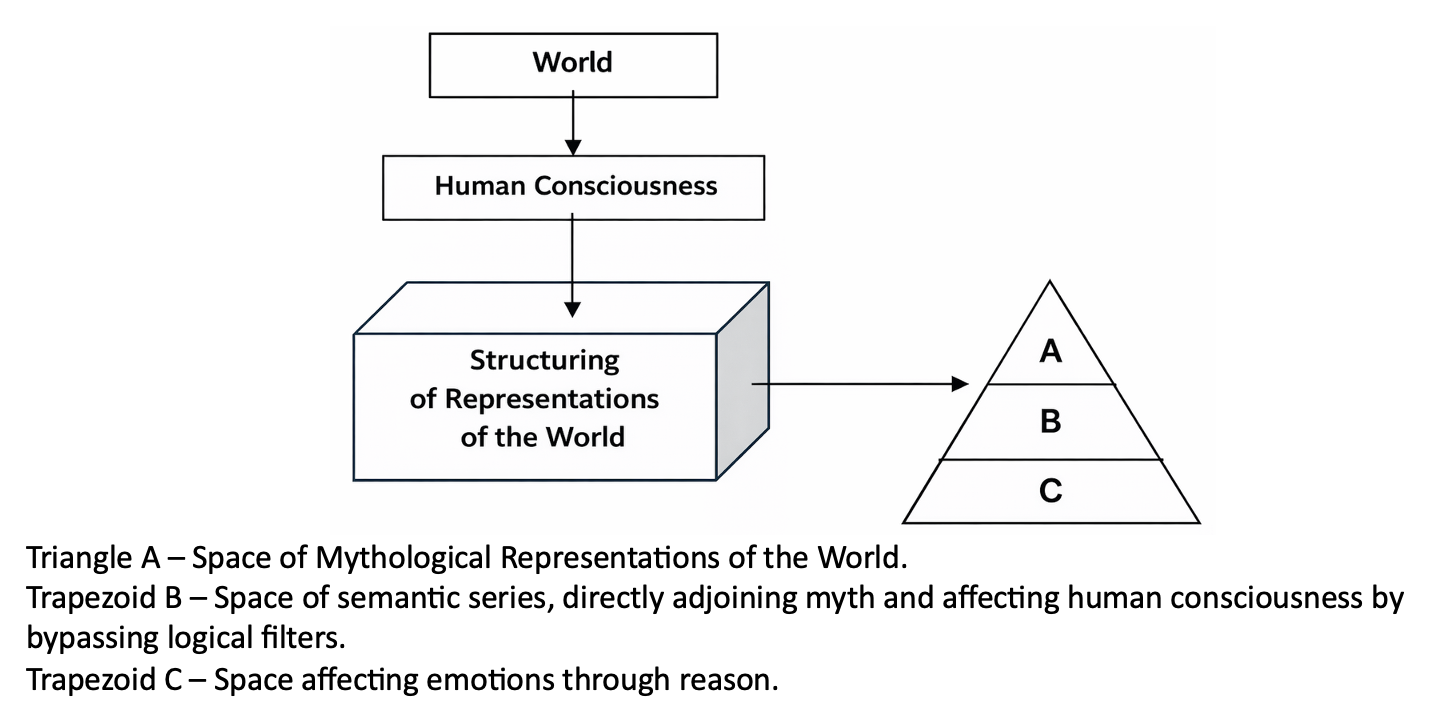
The space of dream images appears to be structured in the same way as the space of images in shamanic verse. This can be illustrated with a drawing (Fig. 5):
Figure 5. Space of Artistic Images in a Work of Art
Space of dreams and space of shamanic verse are represented by triangle A and trapezoid B.
This is why C. Jung managed to identify motifs of ancient myths in the dreams of modern people. Thus, in our model, human dreaming functions as genuine creative activity, which essentially does not differ from the process of creating a poem, or more broadly – a work of art.
We know that the mechanism of word selection and evaluation works differently in different people: in some, more precisely, and in others, worse. Consequently, the quality of dreams in different people should be uneven as well. In relation to the sphere of dreams, we can say that just as there are brilliant poets and brilliant poems, brilliant dreamers who see brilliant dreams also walk among us. (Recall the attitude of the ancients to prophetic dreams.) From this, it also follows that some laws, already identified in artworks, can be applied to dreams. In our view, dreaming can be rightfully evaluated as a genre, unfortunately accessible only to the dreamers themselves, since memories that mean a great deal to them mean nothing to others.[54]
However, from this, it also follows that some laws already identified in dreams can be transferred to artworks.
To explain what is meant, let's quote extensively from J. P. Sartre's novel “Nausea” (1938):
This is what I thought: for the most banal event to become an adventure, you must (and this is enough) begin to recount it. This is what fools people: a man is always a teller of tales, he lives surrounded by his stories and the stories of others, he sees everything that happens to him through them; and he tries to live his own life as if he were telling a story.
<…>
Nothing happens while you live. The scenery changes, people come in and go out, that's all. There are no beginnings. Days are tacked on to days without rhyme or reason, an interminable, monotonous addition.
<…>
That's living. But everything changes when you tell about life; it's a change no one notices: the proof is that people talk about true stories. As if there could possibly be true stories; things happen one way and we tell about them in the opposite sense. You seem to start at the beginning: “It was a fine autumn evening in 1922. I was a notary's clerk in Marommes”. And in reality you have started at the end. It was there, invisible and present, it is the one which gives to words the pomp and value of a beginning. “I was out walking, I had left the town without realizing it, I was thinking about my money troubles”. This sentence, taken simply for what it is, means that the man was absorbed, morose, a hundred leagues from an adventure, exactly in the mood to let things happen without noticing them. But the end is there, transforming everything. For us, the man is already the hero of the story. His moroseness, his money troubles are much more precious than ours, they are all gilded by the light of future passions. And the story goes on in the reverse: instants have stopped piling themselves in a lighthearted way one
on top of the other, they are snapped up by the end of the story which draws them and each one of them in turn, draws out the preceding instant: “It was night, the street was deserted”. The phrase is cast out negligently, it seems superfluous; but we do not let ourselves be caught and we put it aside: this is a piece of information whose value we shall subsequently appreciate. And we feel that the hero has lived all the details of this night like annunciations, promises, or even that he lived only those that were promises, blind and deaf to all that did not herald adventure. We forget that the future was not yet there; the man was walking in a night without forethought, a night which offered him a choice of dull rich prizes, and he did not make his choice.
I wanted the moments of my life to follow and order themselves like those of a life remembered. You might as well try and catch time by the tail.[55]
This excerpt from Sartre is closely connected with the range of problems that interest us. In essence, Sartre says the following:
1. Events in a story must be ordered, while in life they are not ordered (that is, the space of the story is structured).
2. The end in the process of creating a story precedes the beginning and determines the selection of words (that is, a semantic series of words-images can be composed only when the identifier seme of the series is known).
3. Images, while meaning nothing special in the context of their semantic series, build up tension (are remembered for later), that is, their identifier seme is perceived by the reader long before the actual end of the story.
4. It is impossible to truthfully recount a real event since, in speaking, we inevitably structure the space of images of the story, thereby distorting the space in which the particular event took place and which was not structured the way it turned out in the story.
5. The presence of semantic series inevitably leads to a reverse flow of time in the space of artistic images (for creating a semantic series requires knowing the identifier seme first – making the identifier primary and the semantic series secondary).
The first three of Sartre's conclusions repeat principles already set forth by us in the chapters of Part One. The fourth conclusion follows from the concepts about the space of images in artworks developed in the previous chapter. We are interested in the fifth, and the general conclusion the reverse flow of time. Let's try to transfer this conclusion to the sphere of dreams: imagine you are having a dream. An alarm clock rings into your dream. In the dream, it transforms into the toll of a bell. But before you hear it, you will see a series of episodes that will connect the plot of your dream, already unfolded by the time the alarm clock rang, with the bell toll into which the dream transformed the alarm clock ring.
In reality, you first perceived the ring, and your night consciousness created the connecting episodes after the ring was perceived. That is, in your dream, time also flows backward. Scientists have noted this phenomenon repeatedly. We should probably talk about time flowing backward not constantly, but in jumps. We mean the following: if after the alarm clock rings, someone pats you on the hand, this will also somehow enter the dream, possibly after the connecting episodes, but both the connecting episodes and the transformed pat itself will still follow after the “alarm clock” set of episodes.
We will try to build a signal processing model that takes into account all the listed factors and explains them from the positions of semantic series generation.
Obviously, between the moment a signal is registered by the sense organs and the moment it becomes accessible to “night” consciousness (enters the dream and is viewed by the dreamer), some interval of time passes, during which the signal undergoes processing and is prepared for perception by consciousness. Obviously, this processing differs significantly during “daytime” perception of the signal: at night we do not perceive the signal itself, but only its dream transformation. Schematically the process of signal perception in our model is depicted in Figures 6a and 6b.
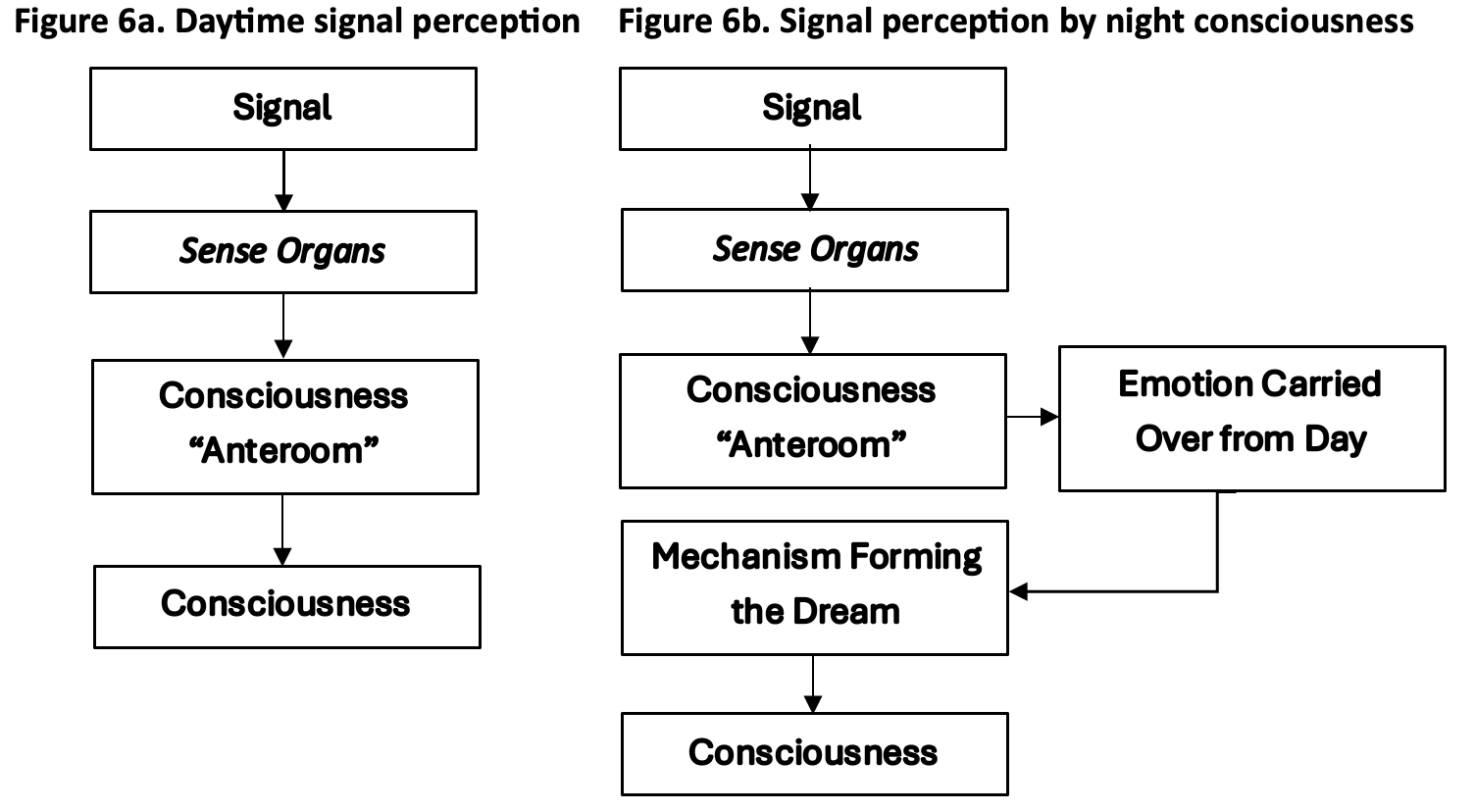
During the day, the signal enters consciousness practically in the same form in which sense organs perceived it (Fig. 6a).[56] During sleep, the signal enters consciousness in a form transformed sometimes beyond recognition by dreaming (Fig. 6b). Having entered the “anteroom”, the signal does not immediately enter consciousness, since access to consciousness is blocked. Instead of entering consciousness, the signal enters the “dream generator”, where it is processed. The “dream generator” is already tuned to a certain emotion. The incoming signal is connected with some memory according to one of the main semes associated with the signal (alarm clock ring with bell toll, for example, according to the seme “ringing”). Saturation with this emotion is extracted from memories as well.
We remember that in our model, the optimal realization of the dream's suggestion formula depends on the optimal saturation of the dream space with an optimally oscillating seme. But by the moment of signal perception, part of the sleep space had already been filled. Therefore, the place in the dream that will be occupied by the memory evoked by the perceived signal depends on whether the seme had oscillated earlier.
We cannot say whether this signal alters the course of the dream by canceling its ending and replacing it with a new one that features the transformed signal, or all the prepared episodes are viewed first and then the dream is extended by several montage pieces. But one thing is clear: the memory generated by the signal can “fit” into the dream directly after a ready montage piece-memory (naturally, the montage piece must complete the syntagm of the dream “phrase” at this point, if it is permissible to apply linguistic terms to night consciousness).
In all other cases, between the previously ready set of montage pieces and the signal transformed into memory, an additional set of montage image memories will be placed, generated later than the memory evoked by the signal. But both with and without connecting episodes entering the dream, time flows backward, since the end (emotion) precedes the beginning (determines the selection of episodes).
Thus, the analogy between the mechanisms of creating shamanic poetry and dreaming in our model turns out to be quite deep and convincing. The model we have built allows us to make a rather interesting assumption, repeatedly declared, however, by the artists themselves: creative activity, in fact, satisfies some vitally necessary need (recall that an organism deprived of REM sleep phases finds itself on the brink of death from nervous exhaustion within just a week).
However, this assumption holds true only if we consider the main purpose of REM sleep to be the creation of dreams and the realization of the suggestion formula – that is, precisely what brings sleep close to artistic creativity. We know so little about the nature of dreams that we cannot reject another possibility: the true significance of REM phase is quite different, while components of artistic creativity are accidental and only accompany certain factors that satisfy vital needs.
Then the birth of art will be viewed not as the emergence of an ability necessary for humans, but as a result of the ancients' failure to understand cause-and-effect relationships. It represents an attempt to satisfy some intuitively vital needs using one of the subsidiary phenomena that accompany the satisfaction of these needs. In this scenario, the accompanying factors like dreaming are mistakenly taken for the root cause.
In our view, something similar led to the emergence of initiation rituals. This will be discussed in depth in Chapter 9.
In conclusion, we emphasize that the material concerning the nature of sleep presented in this chapter in no way claims to provide complete information, and that all conclusions and assumptions we made pertained to the limited poetic model of dreaming, in which we tried to identify some common properties of altered states of consciousness.