Part Two
REALITY OF MYTH
Epigraph 1
“The Ancients knew that all creatures enter but for a short while into life, and must suddenly depart in death. Therefore they gave way to their impulses and did not check their natural propensities”.
“They denied themselves nothing that could give pleasure to their bodies; consequently, as they were not seeking fame. but were following their own nature, they went smoothly on, never at variance with their inclinations. They did not seek for posthumous fame. They neither did anything criminal, and of glory and fame, rank and position, as well as of the span of their life they took no heed”.
Liezi. From Chapter Three “Yang Zhu” https://www.sacred-texts.com/tao/ycgp/ycgp03.htm
“He who knows how to live can walk abroad
Without fear of rhinoceros or tiger.
He will not be wounded in battle.
For in him rhinoceroses can find no place to thrust their horn,
Tigers no place to use their claws,
And weapons no place to pierce.
Why is this so?
Because he has no place for death to enter”.
From Laozi, Tao Te Ching, chapter 50. Translation by Gia-Fu Feng and Jane English. https://www.wussu.com/laotzu/laotzu50.html
The True men of old knew nothing of the love of life or of the hatred of death. Entrance into life occasioned them no joy; the exit from it awakened no resistance. Composedly they went and came. They did not forget what their beginning had been, and they did not inquire into what their end would be. They accepted (their life) and rejoiced in it; they forgot (all fear of death), and returned (to their state before life).
From Zhuangzi Chapter 6, The Great and Most Honoured Master (English translation: James Legge) https://www.taoistic.com/chuangtzu/chuangtzu-06.htm
Epigraph 2
The sea is harmony.
Shapely in debate, all elements cohere.
Rustling in the river's reeds,
musical designs inhere.
Imperturbable form is the outward sign
of nature's utter consonance.
Only our spectral liberty
imparts a sense of dissonance.
Whence this disharmony? How did it arise?
In the general chorus, why this solo refrain?
Why do our souls not sing like the sea
and why must the thinking reed complain?
<…>
Fyodor Tyutchev “Pevuchest’ est’ v morskikh volnakh”, 1865 (Est in arundineis modulatio musica ripis [Lat.]) The Complete Poems of Tyutchev. In An English Translation by Frank Jude, p. 192. http://www.pereplet.ru/moshkow/LITRA/TUTCHEW/english.html
Epigraph 3
Incantation to summon twilight
With ringing sting –
Into clay of honey cup.
No drinking moisture
For Valhalla's daughters,
Clanking with womb
Of water, cold and crimson
In stone chambers
Gods grow mute, and their age
Has passed.
The incantation for summoning twilight was constructed by the authors using the method of semantic series. Each word in it contains the seme of twilight, indistinguishable without special analysis.
Chapter 5
REALITY OF MYTH
Now it is time to state that, according to our model, symmetrical relationships structure not only artistic space but consciousness itself.
Moreover, it appears that this property emerged in human consciousness during humanity's earliest stages when humans were just learning to think and had not yet grasped causal relationships. This property belongs more to the subconscious than to reason. To explain what we mean, we must examine how the mechanism of associations has been investigated. Though Aristotle developed what remains the best classification of associations to date (albeit incomplete), the subject has been studied extensively since his time. There is a vast body of literature on associations, but we are primarily interested in associative experiments.
The first to conduct an associative experiment was Sir Francis Galton, a renowned English scientist and Charles Darwin's cousin. As Dan Slobin summarizes,
He wrote each of 75 different words on a separate card and filed the cards away for several days. Then he looked at the cards one at a time. He timed himself with a stop-watch, starting at the moment the word caught his eye and stopping it as soon as the word had suggested two different ideas. He recorded these ideas as he went through the list but refused to print them. “They lay bare”, he commented, “the foundations of a man's thoughts with a curious distinctness, and exhibit his mental anatomy with more vividness and truth than he would probably care to publish to the world.”[39]
Subsequently, numerous psychologists and psychiatrists have conducted associative experiments, particularly to investigate the laws of thinking. While vast literature exists on verbal association research, we will focus on psychologist James Deese's conclusions from his 1965 book “The Structure of Associations in Language and Thought”.
Deese's insights into the cognitive operations that appear to govern associative mechanisms are of particular significance. Deese maintains that grouping and contrast constitute the fundamental relationships between words. He states (quoted from Slobin):
The data on associative distributions suggest that the two fundamental operations for sorting out meaningful – that is, logical and syntactical relations among words – are contrast and grouping.[40]
From this, Slobin concludes that polar contrast represents a universal linguistic concept. Regarding grouping, its existence is compellingly demonstrated by the phenomenon of semantic generalization, which we examined in Chapter 3.
You can see how Deese's operations align with concepts we discussed earlier: his “grouping” corresponds to our relationships of symmetrical repetition, while his “contrast” manifests as relationships of inversion symmetry. Moreover, Deese's word groups parallel the semantic series we have identified in literary texts – the same series that Luria and Vinogradova discovered through semantic generalization.
It is appropriate to recall that any literary work is, first and foremost, a result of associations. Since the basic operations used by the associative mechanism are operations of grouping and contrast, this results in the symmetrization of the space in an artwork. V. Nalimov believes that moments of creative inspiration arise when thinking transcends logical boundaries.[41] J. Hadamard wrote: “every mental work and especially the work of discovery implies the cooperation of the unconscious”.[42]
It is no coincidence that symmetry manifests most clearly in shamanic verses – verses where logical analysis is almost impossible and which speak not so much to reason as through reason to the subconscious (or as Hadamard would term it, the unconscious). Symmetry also manifests remarkably clearly in the ideological sphere. Consider the oppositions that have permeated our ideology since time immemorial – such fundamental pairs as “us-them”, “friend-enemy”, “good-evil”. What are these if not manifestations of symmetrical relationships? Similarly, is not dualism, which has penetrated the vast majority of known religions, another manifestation of such symmetry? We see this pattern extends even to children's fairy tales with their stark division of characters into good and evil. This division reflects the inversion symmetry of life and death and, by extension, the plots of cosmogonic myths that emerged in prehistoric times.
Jung, however, succeeded in identifying ancient mythological motifs in the dreams of modern people and showing the similarity between paranoid delusions, ancient cosmogonies, and eschatological prophecies.[43] “Where do these archetypes – these ancient universal human images – come from?” asks V. Nalimov.[44] Might the answer to this question lie in studies of resonance phenomena in the brain and the symmetrization of thinking?
The creation of myths and the birth of gods arose from consciousness's fundamental ability to group worldly phenomena into semantic series. Then the seme-identifier would separate and become personified, acquiring qualities (attributes) from its “parent” semantic series. The personification of a seme marked the birth of a new god, while the god's acquisition of attributes marked the birth of a new myth associated with that god.
It probably could be presumed that the content of the seme-identifier of any series participating in the process of “god-birth” must be an emotion, a psychological state of humans during the epoch of “god-birth”.[45] Therefore, all gods “participated” in human life and were connected to humans. The human of the “god-birth” epoch knew nothing of causal relationships, did not try to explain the world logically. The world existed in harmony with human emotions, where each new phenomenon found its place in a corresponding series according to the emotion it evoked. There was no need to explain it – the explanation inhered within the semantic series itself. Logical filters for processing and evaluating information did not yet exist. However, the ability to structure the imagistic space of the world (or more precisely, the space of representations about the world) into symmetrical semantic series, where all elements were equal, did exist. This is the same ability that led to creating the “third plane” in an artwork.
Thus, we have connected the concept of “shamanic verse” with a state of consciousness that differs fundamentally from our familiar logically structured consciousness – a state that appears to have been the only one known to humans of the mythological epoch, humans of the Mousterian period.
But why do we – living in an age where myth has been replaced by the theory of relativity – not engage our logical filters when perceiving works of art?
The daytime, logically structured state of consciousness is not the only state of consciousness available to us. In his already frequently mentioned book, V. Nalimov devotes almost an entire chapter to altered states of consciousness. Here is an incomplete list of altered states that Nalimov describes: mystical, hypnotic, dream-like, and narcotic. In all these states, our logical filters are turned off. It appears that this absence of logical filters was characteristic of mythological consciousness – that is, the consciousness of humans in the epoch of myth birth. What mechanisms activate one state of consciousness or another, we do not know. However, the mechanism for activating the hypnotic state of consciousness is clearly connected with repetition and symmetry – that is, those phenomena present at the “output” of mythological consciousness.
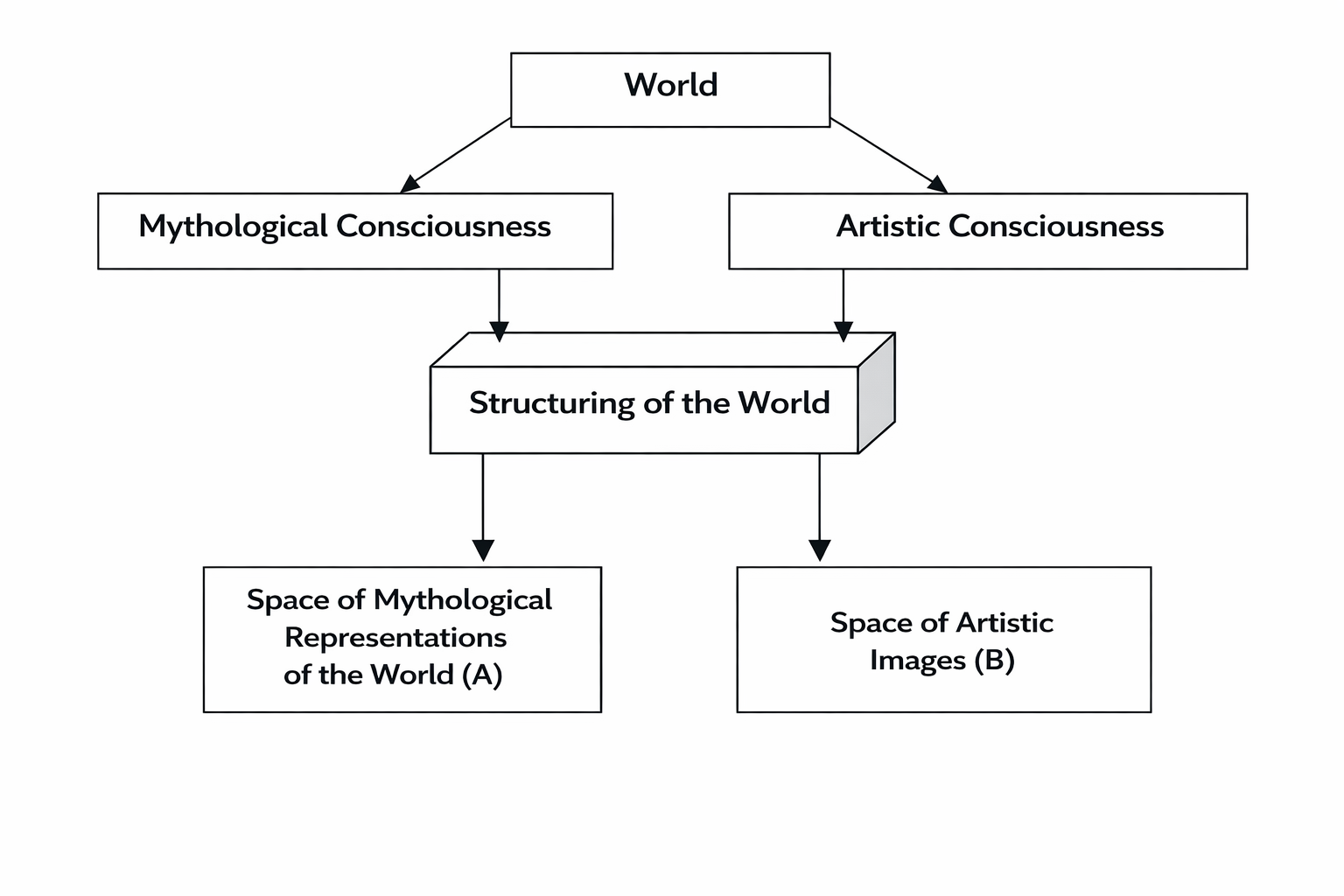
An artwork must contain a “switch” within itself that activates the hypnotic state of consciousness. From this follows a curious conclusion: the space of artistic images proves to be akin to the space of mythological consciousness's representations. This can be demonstrated by the schema shown in Fig. 2.
Figure 2. Schema of World Structuring by Mythological and Artistic Consciousness
In the above schema, the space of mythological representations of images and the space of artistic images, arising from the act of world perception, do not coincide but are structured identically. Spaces A and B may coincide in cases where the artist’s consciousness is of mythological nature. But if we acknowledge that the structuring of mythic space and artistic space is one and the same, should we not acknowledge that some traces of myth must be preserved in artwork? Especially since art, generally speaking, developed from syncretic ritual action. If rudiments of myth have been preserved in works of art, then we must seek them, it seems, at the level of semantic series, at the level of the third plane. This follows from the function of the third plane – the suggestion of emotion – and from our earlier hypothesis that emotions determined the stratification of the world into semantic series as early as in the Mousterian period. Since logically structured consciousness does not recognize the existence of semantic series, the rudiments of myth existing at this level are most likely not recognized either. We will attempt to apply the analytical method presented in the first two chapters to identify mythologems dissolved in the text of literary works.
Before analyzing specific texts, we should address one more point: do we really know what myth is? After all, all myths that have reached us have been altered, perhaps beyond recognition. Yes, this is so. But V. Ya. Propp, in his study “Historical Roots of the Wondertale”,[46] showed the connection between the wonder tale and the complex of myths associated with initiation rites. So, we do have some reference point, and this is the wonder tale.
ANALYSIS 1
An elongated and hard oval,
Black dress's bell-like flares.
Young grandmother! Who kissed
Your haughty lips?Hands that in palace halls
Played Chopin's waltzes,
Along the sides of the icy face
Spiral curls like metal coils.Dark, straight and demanding gaze,
A gaze ready for defense.
Young women do not gaze thus.
Young grandmother, who are you?How many possibilities you carried away
And how many impossibilities.
Into the insatiable abyss of earth,
Twenty-year-old Polish woman.The day was innocent, and the wind was fresh,
Dark stars went out.
Grandmother! This cruel rebellion
In my heart – is it not from you?
This is M. Tsvetaeva's well-known poem “To Grandmother” (1914). The sensation it evokes is difficult to express in discrete linguistic terms – so vague and unfamiliar it is.
The same poet wrote lines at approximately the same time as the poem above (Requiem, 1913):
“How many of them have fallen into this abyss
Gaping in the distance
The day will come when I too will vanish
From the surface of earth”.
These lines evoke a clear and definite sensation – sorrow and fear.
In “To Grandmother”, we find both “the insatiable abyss of earth” and youth disappearing into this abyss – that is, the poems seem to be about essentially the same thing. Yet their suggestion formulas are distinctly different. Let us begin the analysis of “To Grandmother”.
“An elongated and hard oval” – the hardness series. “Black dress's bell-like flares” – the hardness series, since the keyword – bell-shape – evokes association with metal. The dress is evidently starched – hardness, stiffness, unyieldingness. “Young grandmother” – inversion symmetry. It evokes a sense of impossibility – it is impossible to be young and be a grandmother (note that where inversion symmetry appears, not only premonition of loss but also sense of impossibility can arise). “Who kissed your haughty lips?” – the image is highly saturated with the seme of impossibility. A kiss of such haughty lips is impossible. But here too is present the seme of hardness – in the expression of haughty lips. More precisely, not hardness but inaccessibility.
Thus, we clarify: those images that we have already identified as belonging to the hardness series belong to the inaccessibility series (the inaccessibility series being part of the hardness series). So far, we have identified two series, whose identifiers are inaccessibility and impossibility. However, the seme “inaccessibility” itself turns out to be an element of the series with the identifier “impossibility” (it is impossible for a woman to be so inaccessible). Not vice versa, since “impossibility” is a more abstract seme. “Hands that in palace halls // Played Chopin's waltzes” – to play Chopin's waltzes in palace halls was an impossibility for Tsvetaeva (we know that she never became a musician, although in childhood she was predicted a great future as a pianist). This is impossible for us too, dear reader – to play thus and in those halls of those palaces.
“Along the sides of the icy face // Spiral curls like metal coils” – here again is the same hardness, inaccessibility, reducing to the impossibility series. The spiral, like the bell shape, leads back to the notion of chilly metal. But here, another seme emerges – the seme of cold purity. And emerges another seme connected with cold, purity, inaccessibility – sharpness. The spiral is sharp, and incidentally, so is the bell’s edge.
“Dark, straight and demanding gaze, // A gaze ready for defense” – the gaze is dark because it is open (one can see the eyes are dark).
“Defense” and “gaze” gravitate toward sharpness and “inaccessibility”, “straight and demanding” – toward “hardness”. “Young women do not gaze thus” – impossibility, young women cannot gaze this way. “Young grandmother, who are you?” – women in Tsvetaeva's poetry are always very sinful, passionate, earthly – very feminine. But with the grandmother is associated the following complex of qualities: sharpness, inaccessibility, impossibility, cold, purity. All these qualities are completely unthinkable for a typical Tsvetaeva lyrical heroine.
The heroine of the poem is definitely not a woman. What kind of being is it? Tsvetaeva does not know, or rather, Tsvetaeva's reason does not know. But the subconscious suggests an answer: “How many possibilities you carried away, // And how many impossibilities.”– incidentally, here the word “impossibility” is exposed – the identifier of one of the poem's semantic series.
Into the insatiable abyss of earth
Twenty-year-old Polish woman.
This is the answer. Death is the world to which this being belongs. The grandmother’s inherent qualities are instantly explained: cold, purity – the cold of the grave, purification through death.
Hardness, inaccessibility – the impassivity of the deceased, immunity to earthly passions. Sharpness – generally a seme of the death series: the point of a weapon bringing death, the piercing quality of grave cold. And all these qualities merge into one: the impossibility of being so hard, so impassive, so firm and inaccessible – for an earthly woman, a human; impossible for the living to be – dead.
“The day was innocent, and the wind was fresh.” It is clear why the day was innocent: day is light, light is purity, and purity – in that model of the world the verse presents – is death.
Thus, the day was innocent because it was the day of death. The wind’s freshness stems from the same reason. The seme of freshness associates with the seme of cold, purity, and purification – therefore, with the death series. But here, an interesting cyclical pattern emerges: generally, the seme of freshness is connected with the seme of life. Suppose freshness becomes associated with the world of death in this model of the world. In that case, this means that life within death receives affirmation. Death’s vitality is a different form of existence that alone proves to be life, and which grandmother represents in the analyzed verse.
“Dark stars went out” – this phrase can be interpreted thus: when the day of genuine pure existence dawns, the night of sin and life dissipates like smoke. Death comes as liberation from the chains of passion.
Grandmother! This cruel rebellion
In my heart – is it not from you?
Rebellion is an uprisal against the conventional. The conventional is – to live. The poet speaks of her connection to the world of death, of how a Visitor from another world left a particle of another being in the poet's heart. (Note that the word “cruel” is also from the death series.)
It may seem that such an interpretation of the word “rebellion” is contrived. However, here is what M. I. Tsvetaeva herself writes about her understanding of the word “rebellion” in her book “My Pushkin” (1937): “...how could Pushkin not be enchanted by Pugachev, he who had said and proclaimed:
There is rapture in battle
And on the edge of the dark abyss,
And in the raging ocean,
Amid threatening waters and stormy darkness,
And in Arabian hurricane,
And in the breath of Plague!
There is a phenomenon that gives all these phenomena at once. It is called – rebellion, in which we can count also blizzard, and ice-break, and earthquake, and fire, and so much more, not enumerated by Pushkin! and concluded by him in the twice-repeated:
All, all that threatens with destruction,
For mortal heart conceals
Inexplicable delights –
Perhaps a pledge of immortality!
And blessed is one who amid turmoil
Could find and know them.
Pushkin was denied such blessing. The December revolt was a pale reflex of Pugachev revolt. Senate Square was order and in the name of order, whereas Pushkin speaks of destruction for destruction's sake and its bliss”.[47]
For Tsvetaeva, rebellion is to be “on the edge of the dark abyss”. The reader may not believe that Marina Tsvetaeva wrote a poem about the striving for the possibility of a living being to be dead simultaneously – this borders on pathology. Yes, it borders on it. And with Tsvetaeva, it apparently did border on it. Here is what she wrote in her book “The Living about the Living” about Cherubina de Gabriak:
"And the last thing I remember:
O, is it fated that I should know
Love and death at thirteen!– magically and naturally interlocking with my own:
You gave me childhood better than a fairy tale
And give me death – at seventeen!With the difference that she has fated (death), while I have – give".[48]
Mandelstam, with his intuition for semantic series, must have sensed this peculiarity of Tsvetaeva. This explains why, in the poem dedicated to Tsvetaeva (1916), he wrote about her:
Not believing in resurrection's miracle,
We walked in the cemetery.
You know, everywhere earth
Reminds me of those hills
......................................
......................................
<…>
From monastery slopes
A wide meadow runs away.
From Vladimir's expanses
I so did not want to go south.
But in this dark, wooden
And God-foolish settlement,
To stay here with this misty nun
Would mean trouble.
......................................
Commentary, we think, is unnecessary.
Let us sum up. A certain inhabitant of the world of the dead comes to the poet and transforms their nature. The consequence of transformation – an uncontrollable striving toward death, longing for the space of Hades. Significant in every respect is that the poet is connected to the Visitor by blood ties, hence initially ambivalent.
Do we know of any myth with a similar content? Yes, and this is a whole corpus of myths. Dead ancestors appeared to shamans of all known tribes and peoples and helped them travel through three worlds. All knowledge in mythology comes from the world of ancestors (the world of the dead).
Amusingly, if we look at the Christian narrative where a righteous person tells of the kingdom of God, after which the listener strives to get there, then our theme is clearly discernible within it as well.
Strictly speaking, the analysis is complete – we have identified the mythologeme.
ANALYSIS 2
(Mikhail Svetlov, “Grenada”, 1926)
1. We walked at pace,
We galloped in battles,
And the “Yablochko” song
We held in our teeth
Ah, this little song
Is still preserved
By young grass –
Steppe malachite.2. But another song
About a distant land
My comrade carried
With him in the saddle.
He sang, gazing around
At native lands:
“Grenada, Grenada,
Grenada my own!”3. He knew this song
By heart...
Where did the young man get
This Spanish sadness?
Answer, Aleksandrovsk,
And Kharkov, answer:
When did you begin
To sing in Spanish?4. Tell me, Ukraine,
Is it not in this rye
That Taras Shevchenko's
Papakha lies?
Where then, comrade,
Did your song come from:
“Grenada, Grenada,
Grenada my own”?5. He hesitates to answer,
The dreamy Ukrainian:
Brother! Grenada
I found in a book.
Beautiful name,
High honor –
Grenada province
In Spain exists!6. I left my hut,
Went off to war,
To give the land in Grenada
To peasants there.
Farewell, my dear ones,
Farewell, my friends
“Grenada, Grenada,
Grenada my own!”7. We galloped, dreaming
To grasp quickly
Grammar of battle –
Language of batteries.
The sunrise kept rising
And falling again
And the horse grew tired
Of galloping through steppes.8. But the “Yablochko” song
Was played by the squadron
With bows of suffering
On violins of time.
Where then, comrade,
Is your song:
“Grenada, Grenada,
Grenada my own”?9. The pierced body
Slid to the ground,
A comrade for the first time
Left his saddle.
I saw, over the corpse
The moon bent down,
And dead lips
Whispered “Grena...”.10. Yes, to a distant region,
To the expanse beyond the clouds
My comrade departed
And took his song.
Since then native lands
Have not heard:
“Grenada, Grenada,
Grenada my own!”11. The unit did not notice
The loss of a fighter
And the “Yablochko” song
Sang to the end.
Only across the sky quietly
Slid afterward
Onto velvet sunset
A teardrop of rain.12. New songs
Life has invented.
No need, fellows,
To grieve for the song,
No need, no need,
No need, friends.
“Grenada, Grenada,
Grenada my own!”
Let us proceed with our analysis.
1. We walked at pace,
We galloped in battles,
And the “Yablochko” song
We held in our teeth...
Each of these lines repeats the seme of tension. Moreover, the saturation with this seme increases in each subsequent line until it reaches its apex in the image of the song clenched in teeth. The seme of tension is colored by the seme of death implied in the word “battles”. The image of the “Yablochko” song thereby also becomes colored by the seme of death (through context). We know that unprecedented tension must inevitably end in destruction. And it immediately manifests in the form of an inversely symmetric image.
Ah, this little song
Is still preserved
By young grass –
Steppe malachite.
No trace remains of the tension that grated teeth in the previous quatrain – it has destroyed itself. Only fading memory (its fading indicated by the word “still”) is preserved by young grass. But it, too, will soon wither and disappear.
The dominant seme of this quatrain is fading, death. We saw that tension was likewise connected with death in the previous quatrain. There – the death of people, here – the death of memory. The seme of hardness present in the grass image (grass – steppe malachite) is not realized in this context. But the seme of greenness and fragility of both malachite and grass inevitably enters the series of images united by the seme of transience.
2. But another song
About a distant land...
Remember the loneliness series from which we constructed quatrains in Chapter 2? All words in these two lines are taken from that series. In this context, they constitute a series whose seme is alienness.
...My comrade carried
With him in the saddle.
He sang, gazing around
At native lands:
“Grenada, Grenada,
Grenada my own!”
Again, the seme of tension arises. This time, however, it is connected with life rather than death. This occurs partly because native lands are mentioned,[49] carrying deep archetypal associations with sustenance and survival. With the seme of life we associate the saddle (horse) too. The image of the song “Grenada” also becomes saturated here with the seme of life. (The seme of life also appears connected with the seme of contemplation contained in the words “gazing around”.) At the same time, emotionally, the entire life series is also colored by the seme of alienness to a world where people bleed to death (let us not forget that the tension-death series is inversely symmetric to the tension-life series).
3. He knew this song
By heart...
Where did the young man get
This Spanish sadness?
Answer, Aleksandrovsk,
And Kharkov answer:
When did you begin
To sing in Spanish?
The leading seme of this octave is the seme of alienness, foreignness of that cluster of sensations associated with the image of the song “Grenada”. Perhaps it will seem contrived to remind that this image is saturated with the seme of life, but:
4. Tell me, Ukraine,
Is it not in this rye
That Taras Shevchenko's
Papakha lies?
Where then, comrade,
Did your song come from:
“Grenada, Grenada,
Grenada my own”?
Not only does Svetlov mention Taras Shevchenko's name, but he emphasizes his death here, in these same steppes, which, in this model, are literally overwhelmed by the element of death and destruction. The song “Grenada” stands alien to the world of death – this is distinctly felt in the quoted lines.
5. He hesitates to answer,
The dreamy Ukrainian:
Brother! Grenada
I found in a book
Beautiful name,
High honor –
Grenada province
In Spain exists!
Let us break the grammatical connections and simply look at the list of words. Hesitates, answer, dreamy, book, beauty, high, honor, brother, find, Spain, Grenada, province. A series of silence, leisure, and contemplation emerges. The series of spiritual meditation. Slowness in the words “province”, “hesitates”, and “contemplation” in the words “dreamer”, “book”, “beauty”, “high”, “name”, “honor”, and “found”. Of course, as we noted earlier, the contemplation series is part of the life series (meditation is closely connected with spiritual life).
6. I left my hut,
Went off to war...
Hut – life series, all other words – death series.
...To give the land in Grenada
To peasants there.
Life series.
...Farewell, my dear ones,
Farewell, my friends
“Grenada, Grenada,
Grenada my own!”
The dynamics of the alternation of life and death series intensifies, like flashes of black and white colors. “Farewell” – death series, “dear ones”, “friends” – life series. The image of the song “Grenada” belongs to the life series.
In this octave the seme of life overwhelms the seme of death – saturation with the seme of life is clearly greater than with the seme of death.
7. We galloped, dreaming
To grasp quickly
Grammar of battle –
Language of batteries.
The sunrise kept rising
And falling again
And the horse grew tired
Of galloping through steppes.
Here, however, all images are maximally saturated with the seme of death: both the soldiers' striving to conduct battle better, and the impressive image of the sunrise that refuses to die (sunrise – element of the life series), and the horse's weariness (the image of horse, saddle is connected with life), and the steppes which associates with the element of death, as we saw earlier.
8. But the “Yablochko” song
Was played by the squadron
With bows of suffering
On violins of time.
“Yablochko“, as shown above, is the song of death. “Squadron”, “bows of suffering”, “violin”, “time” – here too, the text is overwhelmed by waves of decay and death. Moreover, the saturation with this seme reaches its peak here: playing the violin creates music, the act of which is saturated with the seme of life (this will be discussed in Chapter 8). Here, however, what is born is not life-music but essentially death – a chilling permutation, the picture of the world takes on mythological features, unfolds into phantasmagoria. The pendulum must swing back. Its movement toward the world of non-being has reached its limit.
...Where then, comrade,
Is your song:
“Grenada, Grenada,
Grenada my own”?
Again the life series emerges, but not for long.
9. The pierced body
Slid to the ground,
A comrade for the first time
Left his saddle.
The triumph of the death element. The image of the horse appears for the third time: the saddle was mentioned in octave 2 – as a word of the life series. Horse, tired of galloping through steppes of death – octave 9, and now – the orphaned saddle, the pendulum must begin swinging back.
I saw, over the corpse
The moon bent down,
And dead lips
Whispered “Grena...”.
The moon is often used as a personification of death, the world of darkness, the element of night. (Recall, for example, Lorca's “Ballad of the Moon, Moon”). The moon represents the world of death where a person dissolves. But the world of death emerging in these lines is quite unlike that world of death – steppes which we saw earlier – there, death was associated with gnashing of teeth, with fury, with tension destroying everything – including itself. Here – pacification, tranquility. And moreover, this world of death becomes connected with life: “Dead lips whispered 'Grena...'” Corporeal passions remained in the steppes. Here is something else.
10. Yes, to a distant region,
To the expanse beyond the clouds
My comrade departed
And took his song.
Since then native lands
Have not heard:
“Grenada, Grenada,
Grenada my own!”
Deep peace emanates from the first two lines. They are composed of words saturated with the seme of silence. But we have already encountered the seme of silence. Recall our identification of the seme in octave 5 (”Grenada I found in a book” etc.). The song “Grenada” emerges from the world of silence (we have seen that it is alien to the world of steppes) – and to the world of silence it returns taking the person with it. And in the verse, images of the life series emerge again – “native lands”, “Grenada”, but they evoke a different emotion, the already familiar emotion of luminous sorrow. We saw earlier that where the sensation of luminous sorrow arose, loss was always the theme. Loss is spoken of here too – native lands do not hear the song “Grenada”. The life series has lost some of its constituent elements.
Thus, let us sum up: in the song “Grenada” we find the following group of sensations: sadness, life, alienness (distance), contemplation (silence). And this same group of sensations now characterizes the world of “expanse beyond the clouds”. Complexity arises here, however: the song “Grenada” in Svetlov's work is saturated with the seme of life, yet belongs to the world of silence, alien to the lyrical hero’s world. And when it departs for the world of silence, that world reveals itself as the world of death. Moreover, at the very moment of departure, the song again emerges in the movement of dead lips. Is this the song's extinction or its birth? Isn't the world it is going to the same world it came from? And is this the world of death or of some other, non-human existence?
Here, we have identified a mythologeme: a substance from the world of death that temporarily exists in the human world and returns to its medium. But this mythologeme is not unique in Svetlov's poem.
11. ...The unit did not notice
The loss of a fighter
And the “Yablochko” song
Sang to the end.
Only across the sky quietly
Slid afterward
Onto velvet sunset
A teardrop of rain.
“Yablochko” – the song of death displaces the life song “Grenada”. But the “Yablochko” song itself goes into non-being – it was sung to the end. Not a trace remained of it, only fading memory, as we saw earlier. The dissolution is complete: Death has destroyed itself. And this absolute triumph in the corporeal world – the world of the lyrical hero – ends with an image that interests us: again the seme of silence, of quiet sadness, emerges (remember: “Where did the young man get this Spanish sadness?”). Quiet sadness is connected with the expanse beyond the clouds, and we are again convinced of this.
Very important for us is that precisely here appears the image of rain – rain that brings life to all living things, washing away dirt and blood. Ancient ritual vessels of Trypillia show the image of falling streams of rain – heavenly water, symbol of fertility and pledge of grain's resurrection – symbol of life.
But in the analyzed verse – a self-enclosed model of the world – both emotionally (through the seme of sadness) and through its heavenly, cloudy origin, this symbol of life is connected with the world of death, the world to which the song “Grenada” belongs. This rain, washing the velvet of sunset with tears is a harbinger that there will be sunrise. This is the beginning, the birth of the life series. Rain – and this will be discussed in Chapter 8 – must occupy an important place in the system of archetypal representations.
12. New songs
Life has invented.
No need, fellows,
To grieve for the song...
“No need to grieve” means, essentially, no need to remember. We again come to the theme of memory's extinction, the death of memory, the theme that first sounded at the very beginning of the verse. (“Ah, this little song still preserves/ Young grass.”, etc.).
Moreover: new songs are born, but as we have seen, both songs of the life series and songs of the death series – equally go into non-being. Song is destined for birth and non-being in this model of the world. And a sense of the cyclical nature of being emerges. This sense is reinforced by the poem’s ending:
...No need, no need,
No need, friends.
“Grenada, Grenada,
Grenada my own!”
No need to remember, but the author reminds. The fate of “Grenada” is superimposed on the fate of new songs, on our fate. Did ancient humans remember their tribesmen who had gone beyond the horizon? Does grain remember the grain of last year's harvest? Both yes and no. It remembers in categories of myth. It remembers about the fate of universal grain, universal human. The image of the song “Grenada” in this verse seems to grow into a universal symbol of life. And the cyclical nature of birth and death reveals yet another mythologeme: birth, death and resurrection of vegetative demons of harvest.
Our analysis is complete.
We deliberately applied the method of semantic series identification to analyze such dissimilar poems: Tsvetaeva’s intimate “To Grandmother” and the well-known poem “Grenada” by Svetlov, celebrated for its civic themes. Our aim was to show that regardless of the social orientation a poem or the objectives its author had in mind, any poem – if it evokes emotions in the reader – must be structured into semantic series and must obey the laws of symmetry examined earlier.
We will propose one more supposition: each emotion must correspond to its own mythologeme. If this supposition is true, then the diagram we presented in Fig. 2 should look somewhat different:
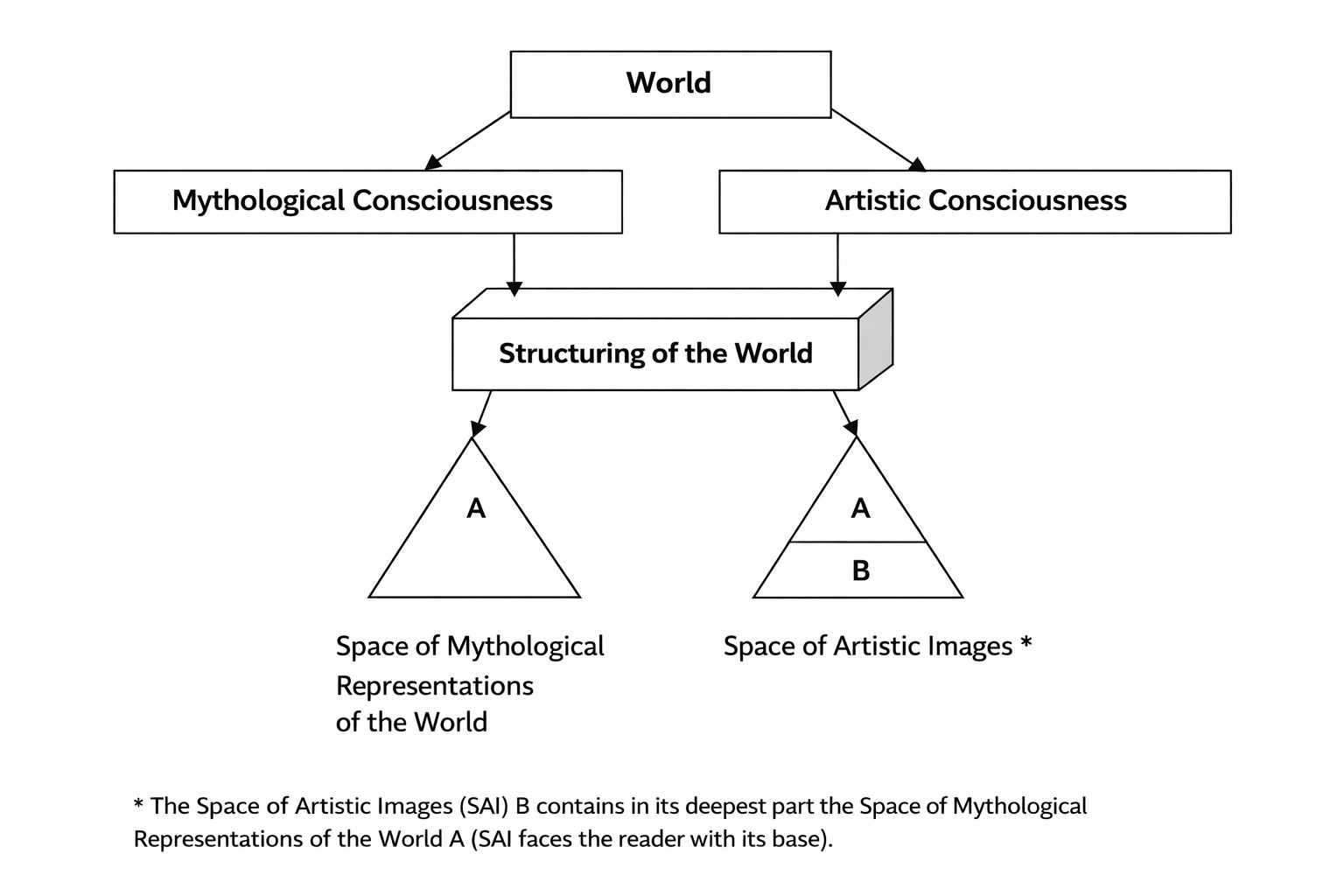
Figure 3. Schema of World Structuring
If different artworks evoke the same emotion, they appeal to the same mythologeme.
Since our analysis was directed at uncovering the peak triangle A – a part of the artistic image space – many layers of the artwork designated in Fig. 3 as trapezoid B, including layers connected with social problems, remained inaccessible to it. This is to be expected. Semantic series characterized the state of prehistoric humans, to whom social contradictions were simply unknown: they lived in the pre-class period of history.
To analyze the layers of a work of art, designated in Figure 3 as the space of trapezoid B, there are traditional, proven methods of literary and art criticism. These methods are not discussed in this paper, as they are sufficiently well known.
In Fig. 3, the space of artistic images is presented as a triangle whose peak corresponds to the primary myth, most likely already inaccessible to researchers. The space of triangle A is the development of mythological plot constructions, the result of fragmentation and development of the primary myth.
However, one might object: the same artwork evokes different emotions in different people. What kind of connection between mythologeme and emotion can we speak of then? We would answer as follows. One artwork may contain multiple mythologemes. However, a specific reader likely perceives only a few of these. In the poem “Grenada” we identified two mythologemes, but we cannot assert that we have exhausted the mythologeme layer of this verse.
Mythological levels of artworks undoubtedly require further careful investigation. It seems that our two analyses already show what a rewarding yet unfortunately unsolved task the investigation of mythological content is, and how much deeper and richer the content of these works is perceived when understood at this level as well. Nevertheless, the inclusion of mythologems in the analytical method significantly enriches and deepens the understanding of artworks’ contents.
As for our diagram of artistic space, in light of the revealed facts, it will take the following form:
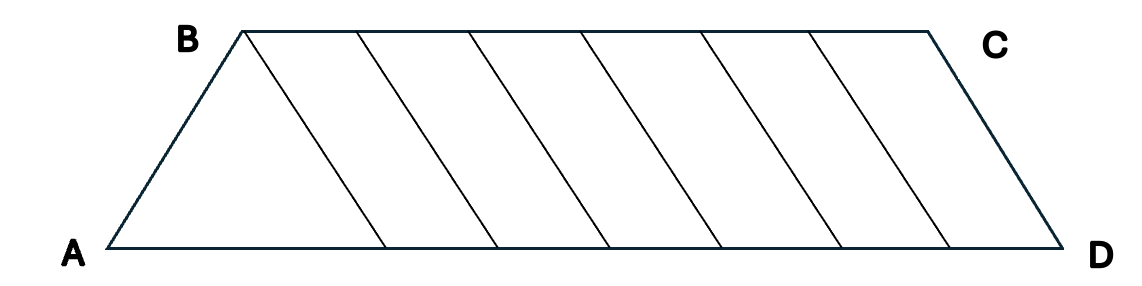
Figure 4. Space of Artistic Images (SAI)
The space of artistic images may be represented as a trapezoid ABCD, containing multiple triangles similar to that shown in Fig. 3. This implies that each perceiver simultaneously perceives one or several mythologems, but not necessarily the entire set. However, we do not exclude the possibility that the multiple mythologemes contained in one artwork are the result of the splitting of one proto-mythologeme, still inaccessible to investigation.
Let us start from answering the question that may arise in the reader's mind: was the poets’ work with semes and mythologems conscious? No, neither Tsvetaeva nor Svetlov were aware that mythologemes were present in their poems, just as they were unaware of the law of semantic series. Clearly, we are dealing with a fundamental property of human thinking, a property that begins to govern consciousness when the mechanisms of logical evaluation of information are disrupted, or when the process of perception occurs without their participation.
Notably, thinking in the logically structured state of consciousness is also connected with grouping concepts into semantic series. However, these semantic series are fundamentally different. Their identifiers comprise not only emotions but also any qualities, concepts and processes, as well as any regularities of the surrounding world. For example, selecting a subset of even numbers from the set of natural numbers means creating a semantic series/row based on the seme of evenness.
Altered states of consciousness, at least one of them, stem from primary mythological consciousness, from which logically structured consciousness also stems.
However, it seems only “logical” consciousness acquired the property of building semantic series according to semes containing no emotions, which leads to the ability to recognize cause-and-effect relationships and to be surprised by contradictions. In the world of clear, logical representations, there is no place for that deep unity of point symmetry and symmetry of repetition, which is observed in the world of semantic series created by altered states of consciousness.
But if logical consciousness operates with semantic series, then even in a world dominated by logic, consciousness's capacity for suggestion plays an important role: wherever semantic series exist, semes are repeated, and thus the symmetry of repetition persists. And this likely corresponds to reality.
Imagine you are home sick. A coworker who has decided to play a joke on you comes by and tells you that you've received a raise. You have no reason not to believe them: you are in good standing with administration; you complete all tasks on time. Logical filters let the information through. And you are excited by the message, you experience the suggested reality as true.
In other words, you believe. All psychological states connected with belief turn out to be ultimately the result of suggestion, and consequently – the result of structuring ideas of the world into semantic series. Thus, everyday life's logical state of consciousness frequently transitions into a hypnotic state of consciousness. This occurs in cases when logical filters let through received “false” information.
Moreover, the logical state of consciousness can increase the power of the suggestion formula through its ability to establish cause-and-effect relationships, which transform into an element of the semantic series forming this very formula. In other words, the logical state of consciousness can be used to intensify the experiencing of suggested reality.