Chapter 7

REVERSE FLOW OF TIME AND MYTHOLOGICAL CONSCIOUSNESS

In Chapter 5, we discussed the relationship between mythological and artistic states of consciousness. In Chapter 6, we put forward the thesis of the reverse flow of time in the space of artistic and dream images in cases where this space is structured by semantic series.

In our model, the space of artistic images and dreams is always structured by semantic series, and mythological space and the space of mythological visions of the world are also always structured by semantic series. The conclusion suggests itself: in our model, humans of the mythological era must have perceived time as flowing from future to past. As paradoxical as it may seem, orientalists have reconstructed traces of precisely such an attitude toward time in Ancient Sumer and Babylon. Here is what Igor S. Klochkov, who dedicated a special essay to the study of ancient Babylonian concepts of time, writes about this:

“The past in everything served as an example for imitation, constantly remained before the mental gaze of ancient man. Psychologically, the Babylonians, like the Sumerians, were oriented in time toward the past. If for modern man 'to look to the future' means 'to look forward', then a Sumerian or Babylonian, looking forward, saw the past; the future lay behind his back. Language data confirms such an orientation, although, of course, one should remember that purely verbal formulas of already overcome concepts can be preserved in language. The past in Akkadian is UM PANI (lit. 'days of the face/front'); the future is AHRATU (formed from the root HR meaning 'to be behind'). AHRATU also means 'offspring'.

Interesting are formations from the root WRK with the general meaning 'to be/move behind': W(ARKU) – 'reverse side', 'back', 'later', 'future', 'behind', 'after'; ARKA – 'henceforth', ARKIS – 'backward'. Two more examples: PANA – 'before' (lit. 'at the face'), INAVAHAR – 'before' (lit. 'in front')” (pp. 28-29).

Having discovered the correspondence 'past' – 'that which is in front', 'future' – 'that which is behind', it is difficult to resist the temptation to place the time vector in a spatial coordinate grid, that is, to try to understand the connection between the concepts of 'past' and 'future' with the concepts of 'up', 'down', 'north', 'south', 'east', 'west'. The construction of such a model is the most artificial and controversial part of our reconstruction; however, it is still justified: the existence of certain connections between direction in space and time among the Babylonians is beyond doubt.

'The past – that which is before the face – in front' we connect with the concept of 'east' (Akkadian: SADU; common Semitic: QDV ('ancient/eastern'), cf. Akkadian 'last year' – SADDAQQDI/A(M) <SATTU + QDM>) and through it with the concept of 'up'; it is also possible that formations from the root HR in addition to the meanings of 'to be behind', 'future' also have the meaning 'west'. In graphic form, our reconstruction can be presented as follows (Fig. 7):
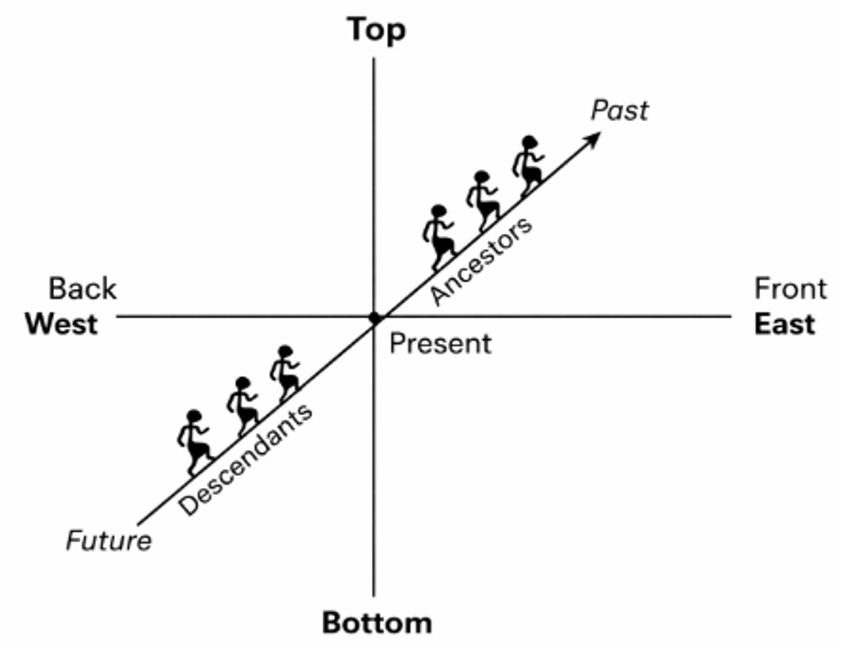
Figure 7. Model of time-spatial orientation in Ancient Sumer and Babylon

Of course, such a model is highly hypothetical”.[57]

Thus, movement in time in Klochkov's model is an ascent from future to past. His hypothesis is indirectly confirmed by the perception of time in dreams. I. S. Klochkov draws attention to the fact that orientation toward the past was characteristic of ancient and medieval cultures and suggests that the psychological turn “facing the future” began, evidently, in the middle of the 1st millennium BCE under the influence of messianic teachings and eschatological expectations, which led to the transfer of attention to the future. This turn was completed in modern times.

It seems to us that the process of reorientation in time is connected not so much with messianic teachings as with the emergence (discovery?) of other forms of consciousness, different from the mythological and possessing logical filters (in fact, messianic teachings are a consequence of the emergence of logical thinking). This process did not end in modern times, since even today, as soon as we plunge into the world of dreams or artistic fiction, we again, without realizing it, perceive time as flowing backward.

We can speak of the temporal reorientation of “logical consciousness”. It probably ended at the turn of the 2nd-3rd centuries CE. This period, as we shall see later, was generally a period of global changes: it was by the 3rd century that eloquence died out, the magic of the word was forgotten, and the era that we will call in the next chapter the “era of the initial impulse” came to an end.