Chapter 8
THE ERA OF INITIAL IMPULSE
The outstanding Russian traveler and scientist Nicholas Miklouho-Maclay studied customs and habits of Papuans, among whom he lived a long time. He was among the first to draw attention to a strange phenomenon: the natives perceived words quite differently from Europeans. For a European, a word is just a word. For a Papuan, a word was equivalent to action. Even in cases where the information carried by the words was knowingly false, it evoked an intense experience of the sensations associated with it. Moreover, as a rule, the Papuans were very sparse with words. Their speech phrases often consisted of a single word.
Today, a researcher can confidently assert that everything above applies to all known tribes at a primitive stage of development. The taciturnity of Native Americans has become proverbial. We remember the Europeans' surprise when encountering the phenomenon of Native American eloquence, accompanied by a very serious, almost superstitious attitude toward the word. It seems that for modern primitive people, a word means much more than it does for a European.
We remember that in the ancient culture, eloquence was valued very highly. History has preserved the names of great orators of Athens and Rome, whose speeches affected listeners almost as strongly as the speech of an Indian chief affected his tribesmen. However, the sophisticated speeches of ancient declaimers were already constructed taking into account the requirements of rhetoric and knowledge of sophistry. We know when eloquence died. We know this thanks to the sage Tacitus, before whose eyes orators were disappearing without waiting for a replacement. Tacitus felt that the death of eloquence indicated the beginning of a new era. We will call this era the era of lost initial impulse.
So, let us reconstruct the line of development of the phenomenon of eloquence, or rather, that segment of this line that is accessible to the historian:
The word evokes intense experience, and it is perceived as reality. Logical filters are turned off.
To evoke intense experience in listeners, one needs to construct speech skillfully. The ability to deliver speeches is rated so highly that the names of the best orators end up on the tablets of history.
The art of eloquence dies along with the world of antiquity.
In previous chapters, we said that if a person experiences illusory reality as true, it means that the illusory reality has been suggested to the person.[58] Suggestion? But for suggestion to occur, repetition, rhythm, semantic series are necessary.
If a word causes a powerful hypnotic state in a Papuan, then the very act of pronouncing the word must contain a hidden repetition of the mental state being suggested. We think that repetition does take place. It should be realized in the set of sounds (the Expression Plane of the word) evoking the same mental state as the seme that is fixed behind this set of sounds (the Content Plane of the word).[59]
But here we find ourselves on very slippery ground. It is currently accepted in linguistics and philosophy that the content plane and the expression plane of a word (the field of word meanings and the set of sounds identifying that meaning field) are linked arbitrarily, and therefore the same concept is denoted by different sets of sounds in different languages. Moreover, the same set of sounds can denote completely different concepts in different languages. Yes, all this is true, and this position is valid. But it is valid for languages that have undergone a long process of development. And even then, with some caveats, which we will discuss below.
Outstanding thinkers of antiquity, belonging to different epochs and living in different places, unanimously declared that the connection between word and concept cannot be arbitrary. Let us listen to their voices. They lived closer to the era of initial impulse, and perhaps the properties that allowed humanity to create language were not yet completely lost by the 2nd-3rd century BCE, the boundary that separates the epochs of living and dead eloquence.[60]
The Old Testament:
“So God formed from the dirt of the ground all the animals of the field and all the birds of the air. He brought them to the Man to see what he would name them. Whatever the Man called each living creature, that was its name. The Man named the cattle, named the birds of the air, named the wild animals; but he didn’t find a suitable companion”.
Genesis, Book 2, 19-20[61]
Sayings of Confucius:
The Master said, “A transmitter and not a maker” … [7-1]
The Master said, “I would prefer not speaking”. Zi Gong said, “If you, Master, do not speak, what shall we, your disciples, have to record?” The Master said, “Does Heaven speak? The four seasons pursue their courses, and all things are continually being produced, but does Heaven say anything?” [17-19]
If names be not correct, language is not in accordance with the truth of things. If language be not in accordance with the truth of things, affairs cannot be carried on to success. [13-3]
Plato:
“Socrates: ...Names must be given as, in accordance with nature, they should be given and received, and with that which is by nature intended for this purpose, and not as we please... Thus, not every person, Hermogenes, is given to establish names, but only such as we called the Creator of Names. He, it seems, is also the Lawgiver. … Thus, my most precious one, the Lawgiver we speak of must also be able to embody in sounds the name that is in each case designated by nature”.
… Socrates: Names ought to be given according to a natural process, and with a proper instrument, and not at our pleasure: in this and no other way shall we name with success …
… Then, Hermogenes, not every man is able to give a name, but only a maker of names; and this is the legislator, who of all skilled artisans in the world is the rarest.
… Ought not our legislator also to know how to put the true natural names of each thing into sounds and syllables and to make and give all names with a view to the ideal name, if he is to be a namer in any true sense? [64]
We have quoted from three classical books, each representing its own historical culture. First, the Old Testament, behind which stands the world of steppe nomads; next, Plato's “Dialogues”, born in the depths of the priceless ancient culture; and finally, the canonical book of ancient China “Lun Yu”. A similar view of the dependence of word and concept existed in ancient India.[65]
The Judean steppe, ancient India, China, Athens. Four great spiritual sources of antiquity. And the same understanding of the connection between word and world. Confucius's followers even created a school of name correction. Following their teacher, they believed that once, the word unambiguously embodied the thing. But since then, the connection has been distorted and lost, and it needs to be restored to harmony. The words need to be corrected so that they again correspond to things.
The words needed to be corrected because “if names be not correct, language is not in accordance with the truth of things. If language be not in accordance with the truth of things, affairs cannot be carried on to success. When affairs cannot be carried on to success, proprieties and music will not flourish”. [66]
Thus, we see that the very idea of a rigid connection between the expression plane and the content plane is, to put it mildly, not new.
This old concept is gaining unexpected confirmation today thanks to research by St. Petersburg neurophysiologists at the Bekhterev Institute. We have already mentioned that they managed to establish a fact whose importance for linguistics and philosophy is difficult to overestimate: the same brain cell responds to stimulation by sound, seme, and drawing. This confirms our assumption that a repetition of the seme can be concealed within a single act of word pronunciation. Obviously, due to some reasons (possibly due to less informational noise in brain cells), the consciousness of a person who stood at a primitive stage of development was more receptive to repetitions of semes than the consciousness of civilized man.
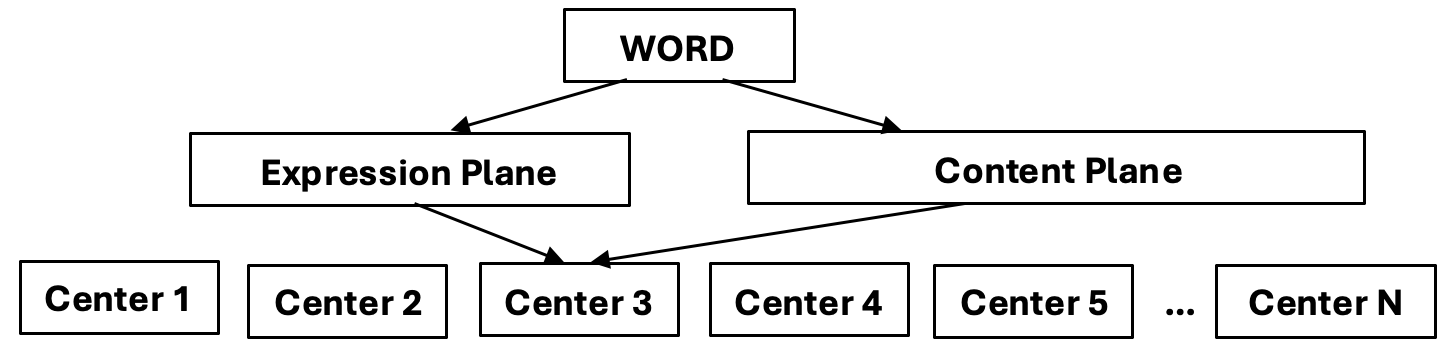
We will attempt to put forward a model of language origin and development. This model is based on two key insights. First, language emerged as a form of creative activity, which, as we saw above, operates through semantic series. Second, at a very early developmental stage – the stage where Papuan tribes' development halted – when one person created (pronounced) a word, it produced a powerful hypnotic effect on their listener: the word became equivalent to action itself. In our model, this effect was achieved because both sound and seme acted on the same nerve centers, as shown in Fig. 8.
Figure 8. Stimulation of one and the same brain center by different levels of the word
Most likely, those centers that were synchronously activated by both planes of the word were centers of emotional stimulation. Naturally, besides the center of a certain emotion, the word could stimulate other centers, but in our model, it is still precisely the emotion centers that should be stimulated synchronously. We emphasize synchronousness of all levels of the word – that is, those centers that can be affected by different sound combinations carrying no semantic load except emotional. As a result, a suggested mental state and the experience of the suggested reality emerged.
Thus, in our model of language formation, not just any set of sounds should have become associated with a particular phenomenon of reality, but only one, or one of several, causing in a person the same emotion and mental state as the named phenomenon of reality. It is precisely emotion that performs the function of a rigid connection between the expression and content planes.[67]
But, in principle, any phenomenon of reality can evoke opposite emotions, and opposite emotions transition into one another (inverse symmetry, again). The representation of each object corresponds to its own emotional field, and one can speak of contextual realization of emotion and of a priori meanings of the image, just as we did earlier when analyzing words.
Obviously, it was precisely the a priori emotional representation of a given phenomenon that determined the choice of sounds for its identification. However, what about the fact that different people may a priori associate an opposite spectrum of emotions with the same object? From this, a conclusion follows: for a set of sounds to correspond to the emotion evoked by a given object, more than just accurate sound selection is needed (and likely not all people were equally skilled at matching sounds to emotions). Some stimulus is also required – a factor preventing listeners from simply substituting their own a priori representation of an object when they experience the emotion evoked by hearing a particular sound combination. In other words, some motivating factor is needed that would compel a person to actively seek to understand the actual meaning behind a sound combination pronounced by another person rather than simply projecting their own associations onto it. We will talk about this stimulus later.
For now, let us note only that, in our model, the correspondence of the expression and content planes’ emotion-link of the word is a necessary but insufficient condition for the birth of the word. What is crucial for us is that we are again dealing with emotion, essentially with a semantic series, since the expression and content planes of the word form a series with an identifier – the seme-emotion. In principle, the act of word birth represents a process of creating a suggestion formula. In our model, the main criterion applied to the word's suggestion formula is the optimal saturation of the word with emotion. The expression plane of the word and its content plane form a semantic series. The ability to build an optimal suggestion formula from seme and sound combination must have been one of the necessary qualities of the “Master of Names”, the “Universal Craftsman”.
The birth of language in this model is conditioned, particularly, by our consciousness's ability to build semantic series and be subject to suggestion. However, while this ability could lead to the emergence of the word, it could not preserve the emotion-link. Any reaction to any object changes a person's mental state. Significantly, not all objects and phenomena of the surrounding world in our model had to evoke a reaction from humans of the language birth era.
Remember that when a tourist begins to admire the beauty of some cliff, the local resident merely shrugs their shoulders: they neither perceive the special qualities of the cliff that fascinate the tourist, nor do they even register the cliff itself as noteworthy. Something similar to the effect of semantic saturation occurs.
Probably, humans reacted to objects and phenomena of the surrounding world that somehow influenced their lives, in whatever way that may have been, and did not react to neutral objects. Hence, it follows that at the moment of language birth, words must have emerged to designate precisely those objects and phenomena of the habitat that somehow influenced the tribe's survival. We are inclined to think that the same emotion, experienced with different intensities, causes different mental states because the more strongly a center of nervous activity is stimulated, the more extensive inhibition around it arises. Consequently, the intensity of stimulation in neighboring centers is suppressed. This means that mental states caused by strong and weak experiences of emotion are different. Since there are no two objects or phenomena of reality causing an identical mental state, in our model, a corresponding set of sounds had to be selected to designate each of them. Initially, the number of words in the language was probably limited by the number of experienced mental states.
Language emerging in this way was closely connected with the world and conditioned by it, reflecting connections between objects of the world as Mousterian humans understood them. This was an emotional model of the world generated by the consciousness of Mousterian humans. In this period of language emergence, all words must have been unambiguous, with each set of sounds corresponding to one undivided seme. The word carried within itself a powerful suggestive charge. It is difficult for us to imagine the power of words at that time. After all, our words are no more than worn shadows of those that appeared at the very beginning. Probably, words were used only on special occasions. Perhaps it was during that period that the custom of forbidden words arose, traces of which survive to this day both in explicit form (the prohibition on swearing) and in implicit, unconscious form – “medved'” (bear) literally means “honey-knower”, which is not the genuine name of the animal but a veiled designation. The true tabooed name is preserved in the word “berloga” (lair of the ber). This word – ber – corresponds to the English bear, the German Bär, and the Latin barbus. The euphemistic nickname entered the language, as B. Rybakov noted, while the original forbidden name was not preserved.[68] It is known that in primitive hunting collectives, mockery and cursing were perceived as very severe punishment.[69]
It is also known what role curses and blessings played in much later times. The world hypnotized ancient humans. This is how their consciousness functioned.
Sartre in his novel “Nausea”, an extensive quote from which was given in the previous chapter, writes about how as soon as one begins to structure the world into semantic series – immediately there appears a sense of adventure (naturally, Sartre expresses this idea somewhat differently, not using the term “semantic series”). Many have described the mental state in which random events are perceived as proper, natural, and necessary (one tends to see a reflection of their emotions in all external things). This is precisely the structuring of the world into semantic series, usually arising under the influence of strong experience. Ancient humans must have lived in a fascinating world.
But within the very nature of language, according to our model, lurked the seed of its own mortification. As we noted earlier, the semantic unity of sound and seme is a necessary but insufficient condition for language birth. It is insufficient because people perceive the world differently, and what serves as an ideal suggestion formula for one person might not affect another with the same intensity. Therefore, some additional component was needed, some stimulus that would compel people to establish connections between sound and seme. In our model, this very component ultimately caused language's mortification.
To explain what is meant, we will have to digress and move to a topic that, at first glance, is quite far from language and related problems. Throughout all historical epochs, humans have faced situations that offer a choice between life and death. In every age of human existence, people have chosen death in certain circumstances. If we look closely at the diversity of situations leading humans to conscious self-sacrifice, we will see some common seme in all such situations.
Humans chose death:
obtaining or defending food (without it, they were doomed to starvation);
defending the interests of the clan (without the clan, they were doomed to physical death in a world where a loner could not survive);
protecting their children or family (which goes back to defending clan interests);
defending their abstract ideas (the death of Giordano Bruno).
The first three reasons can be united into a semantic series of life. They are understandable and naturally go back to the problem of biological survival. The fourth point stands apart. What connection do abstract mental constructions, artificial connections, or any ordering and structuring of our mental representations of the world have to human biological survival? How does this creative mental activity relate to our survival as a species? S. Freud believed that creative activity is a sublimation of the sexual act. We are inclined to think that he was both right and wrong. Freud was right about one thing: creative activity does indeed evoke in humans sensations remarkably similar to those experienced during orgasm.
More convincing than any references to scientific authorities, in our view, is a reference to the testimony of a person who possessed enormous creative potential – to A. S. Pushkin.
Here is how he describes his sensations during the creative process (1833):
X
And I forget the world – and in sweet silence
I am sweetly lulled by my imagination,
And poetry awakens in me:
The soul constricts with lyrical excitement,
Trembles and sounds, and seeks as if in sleep,
To pour forth, finally, in free manifestation –
And then to me comes an invisible swarm of guests,
Old acquaintances, fruits of my dream.
XI
And thoughts in the head surge in daring,
And light rhymes run to meet them,
And fingers beg for the pen, pen for paper,
A minute – and verses will freely flow...[70]
If we identify the semantic series of images in this excerpt, we get the following complex of sensations: 1) concentration on one's sensations, 2) sweetness, 3) trembling, surging substance, unconsciously (as in sleep, that is, without the participation of reason) striving to pour forth, 4) freedom and lightness connected with the pouring forth of the trembling substance (rhymes, words).
From this point forward, we will refer to the complex of sensations connected with creativity as the complex of fertility (in the initial period of writing emergence in Sumer, the goddess of harvest and fertility Nisaba was considered to be the patron of scribes).[71] Language reflects a feature of human thinking that is very important for our analysis: the word “birth” is applicable to all products of mental activity, as well as to all human emotions. We believe that the association of the word “birth” with terms like “thought” is not coincidental. Rather, in the era when language itself was emerging, thought (the process of structuring one's mental representation of the world) was conceived as something living – something that is born and requires protection, just like living children. The outcomes of all creative processes were conceived as living beings.[72] From our perspective, this is precisely why Freud was mistaken in viewing art merely as a sublimation of the sexual act. Art and the sexual act in our model are equal: art led to the birth of a living organism, like any creative (mental) activity.
In our model, creative activity existed initially at the level of dreams and at the level of structuring representations of the world into semantic series according to emotions. We already know that without sleep, humans die. We already know that creative activity brings pleasure. But pleasure must inevitably stimulate the development of thinking (by thinking we understand the process of establishing connections between previously unconnected entities).
In our model, this pleasure must have become the stimulus that could prompt humans to recognize the connection between sound and seme in the newborn word. Having established some connection between objects, humans experienced pleasure and, for it to repeat, a stimulus was required. This stimulus could be the word. It is precisely the pleasure that humans experienced from the process of thinking that could stimulate the development of logical thinking and ultimately – the recognition of cause-and-effect relationships.
But that moment when humans learned to comprehend the world became the beginning of the end of the era of initial impulse. As applied to language, this meant the beginning of the process of seme fragmentation. As soon as humans began to discover new properties in objects and phenomena of the surrounding world, the emotions that these objects and phenomena had previously evoked changed. The link between sound and seme ceased to exist.
All further development of language can be likened to the “development” of a corpse in a sealed chamber – language ceased to be a model of world reflection, turned into a monstrous hierarchical system, very conservative, and, most importantly, far from universal. The point is that the more qualities humans discovered in an object, the more the meaning that stood behind the expression plane in the word naming this object fragmented into components. Recall that initially, this meaning was undivided. The fragmentation of primary meaning can be likened to the fall of an avalanche – this is an unstoppable process, continuing to this day.
For newly emerging meanings, one would need to find a sound identifier: create a new word. However, language follows the law of economy – introducing too many words would exceed human memory capacity. Therefore, new meanings become attached to old words. This creates the polymorphism of words; with it, the living connection between sound and meaning finally dies.
However, it's clear that for a new meaning to become attached to a word, this new meaning must be firmly recognized by all members of the speech community. In other words, a significant period of time must elapse between when a new meaning first separates from the disintegrating semantic nucleus and when that meaning becomes established in the language. Meanings fragment much faster than they are assimilated by language. As a result, language can only express the meanings that have already become established, not the full spectrum of possible semantic content. A huge number of fragmenting meanings turns out to be inaccessible to language. About these “invisible” meanings we can assert only that they exist, and that they relate hierarchically. But we cannot isolate them – we have no apparatus for this.
However, precisely these invisible hierarchies determine language's future, guiding the development of its semantics. To operate with them, it is necessary to create a special new language, which is impossible and meaningless, since it will instantly become obsolete and cease to perform its functions. Hence, the gap between the fragmentation of meaning and the polymorphism of language constantly widens. Perhaps when this disparity reaches a critical point, language will die – we do not know.
Thus, language is not able to adequately express all the diversity of existing meanings. Isn't this the source of that awareness of the word's imperfection that haunted Tyutchev?[73]
However, it turns out that words are unable to express not only the smallest particles of meaning. Those primary meanings from which everything began, meanings that were once undivided, have also become inexpressible. Thus, the developmental scale of each word's meanings, figuratively speaking, takes this form (Fig. 9):
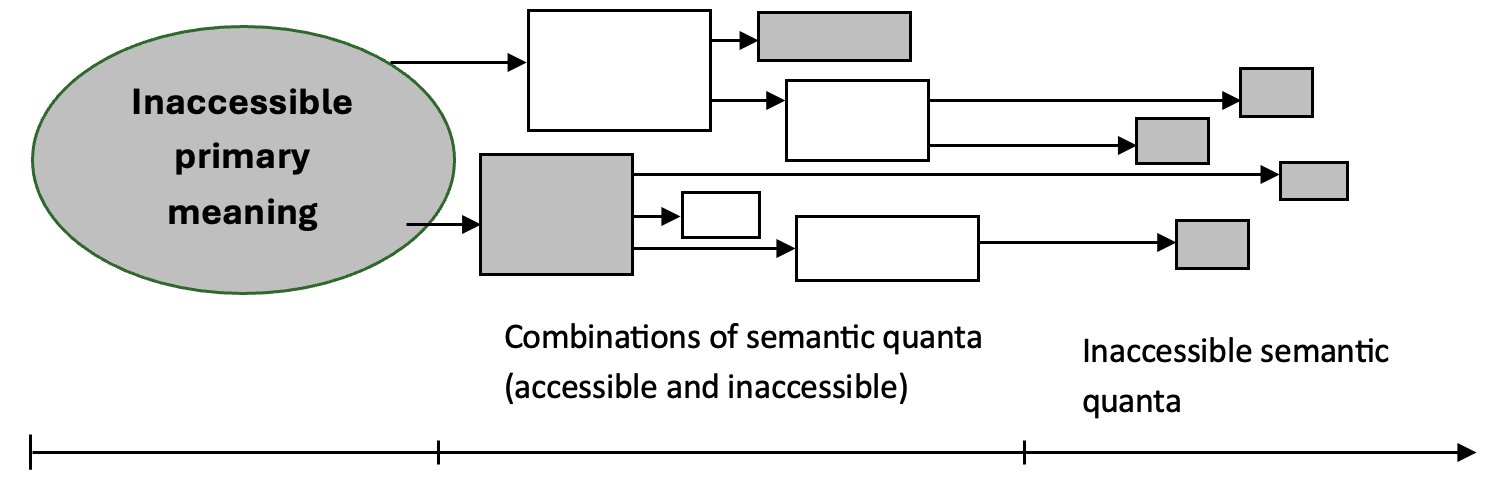
Figure 9. Scale of development of word meanings
The semantic scale is limited, on one side, by the primary seme, on the other – by semantic quanta. By primary seme, we understand the word's primary meaning, and by semantic quantum – the smallest, at a given moment indivisible further meaning of the word (approximately the same thing that Heidegger called “absolute meaning”). We emphasize that a semantic quantum is not indivisible by its nature. It is a meaning that cannot be further divided at the present moment, though it inherently possesses the potential for divisibility. Both inaccessible and accessible meanings form the meaning field of a given word. As stated in the beginning of the study, the part of the meaning field realized in a phrase we call a seme. Every seme is a combination of semantic quanta. The expression plane is only an identifier of the meaning field of the word.
Our model allows us to explain the reasons that led to the rejection of the word as a means of communication in several Eastern teachings. We have already spoken about the school of name correction. The Taoists were skeptical of the word: “Those who know do not talk. Those who talk do not know”, states one of their maxims.[74] Zhuangzi said: “The Tao, manifesting itself in words, is no longer the Tao, words, becoming logically derived judgments, do not reach the truth of the unthinkable”.[75] “Words exist because of meaning; once you’ve gotten the meaning, you can forget the words. Where can I find a man who has forgotten words so I can have a word with him?”[76] Zhuangzi sought to find the absolute word that would evoke a representation of the Tao in undivided consciousness.
It is known that the followers of Chan Buddhism denied the word as a means of communication: they believed that reality should not be told about but experienced. But the crucial point is that language, at the moment of its emergence, precisely fulfilled this function – it allowed people to experience a suggested reality that didn't exist in the present moment, thanks to the suggestive function of language's main instrument: the word.
Thus, our model to some extent removes the contradiction between the culture of the Word and the culture of Silence. We discover that the goals pursued by the culture of the Word at its moment of emergence and those pursued by numerous cultures of Silence – from Hesychasm to Chan Buddhism – turn out to be remarkably similar. Words evoked the experience of undivided mental states – those fundamental states through which early humans structured their world, where all objects evoking a particular mental state became part of one semantic series. The personification of the seme-identifier of such a series, i.e. the seme of emotion, the seme of undivided mental state, as we have said previously, meant the birth of God (and endowing God with attributes chosen from objects entering into the semantic series of this seme meant the birth of myth).
Thus, if there existed a word denoting this mental state – an undivided seme of emotion, then from this inevitably follows that the word was immanent to God[77] (the complex of fertility in our model additionally strengthened this immanence, leading to the word being conceived as living). In any case, Myth turns out to be closely connected with the Word, which precedes it. Together they can form a single whole, with the Word functioning as a hypostasis of Myth.
But if this is so, then mythologemes encoded in a work of art should reveal to us the very primary semes, that is, mental states close to states experienced by humans of the era of initial impulse. As the word's suggestive power began to fade due to the fragmentation of primary semes and the broken link between expression and content planes, people turned to poetry to evoke specific mental states during rituals, warfare, and hunting. The mythologemes embedded within semantic series could still produce effects on the human psyche that isolated words had lost the power to create.
“In those times when hyangga dominated,[78] the attitude toward the poetic word in Korean culture was special. Poetic works were magical. The composition, writing, performance of hyangga presupposed influence on the world as a whole or on its individual phenomena. Hyangga were incorporated into funeral rituals, prayers to avert national disasters, shamanic healing incantations, and other Buddhist ceremonies. Hyangga were composed and performed in critical situations in the fate of individuals and in the fate of the state. Appeal to the poetic word was a matter of responsibility. A person who composed and performed hyangga had to possess the moral right to its composition and performance. He specially prepared for this act <...> chose the appropriate time”.[79]
And now we realize that the creation of an artwork (in particular music and verses, and initially, obviously, even the mere use of words) was such an important and responsible matter also because composition itself was conceived as a form of birth. A genie was practically being released from the bottle into the world.
“We recall that in the legendary China of the Old Kings, music was accorded a dominant place in state and court. It was held that if music throve, all was well with culture and morality and with the kingdom itself. The music masters were required to be the strictest guardians of the original purity of the “venerable keys”. If music decayed, that was taken as a sure sign of the downfall of the regime and the state. The poets told horrific fables about the forbidden, diabolic, heaven-offending keys, such as the Tsing Shang key, and Tsing Tse, the “music of decline”; no sooner were these wicked notes struck in the Royal Palace than the sky darkened, the walls trembled and collapsed, and kingdom and sovereign went to their doom”.[80]
“Music is founded on the harmony between heaven and earth, on the concord of obscurity and brightness.
Decaying states and men ripe for doom do not, of course, lack music either, but their music is not serene. Therefore, the more tempestuous the music, the more doleful are the people, the more imperiled the country, the more the sovereign declines. In this way the essence of music is lost.
What all sacred sovereigns have loved in music was its serenity. The tyrants Giae and Jou Sin made tempestuous music. They thought loud sounds beautiful and massed effects interesting. They strove for new and rare tonal effects, for notes which no ear had ever heard hitherto. They sought to surpass each other, and overstepped all bounds.
The cause of the degeneration of the Chu state was its invention of magic music. Such music is indeed tempestuous enough, but in truth it has departed from the essence of music. Because it has departed from the essence of real music, this music is not serene. If music is not serene, the people grumble and life is deranged. All this arises from mistaking the nature of music and seeking only tempestuous tonal effects.
Therefore the music of a well-ordered age is calm and cheerful, and so is its government. The music of a restive age is excited and fierce, and its government is perverted. The music of a decaying state is sentimental and sad, and its government is imperiled”.[81]